


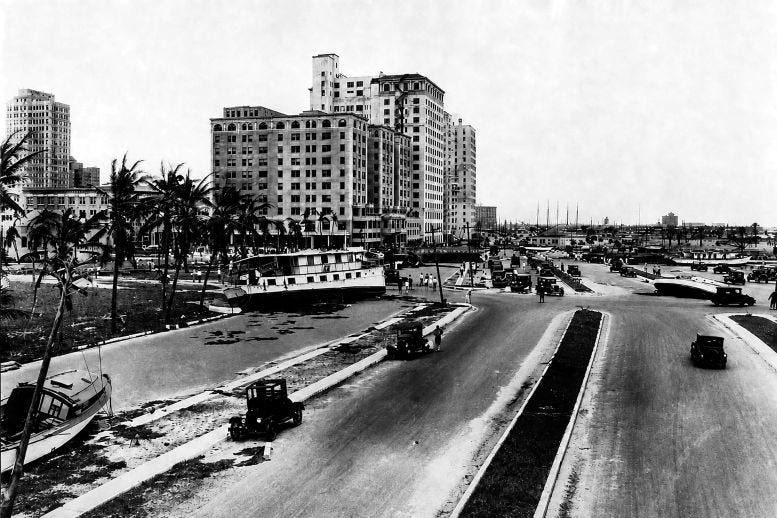
For those who lived through it, the Great Miami Hurricane of 1926 was the big one. In the early morning hours of Saturday, September 18, the eye of the hurricane swept across Miami Beach before moving over downtown Miami. A powerful tidal wave inundated portions of the barrier island, leaving many residents fearing that Miami Beach had been virtually swept away. For thousands who endured the hurricane, it was their first experience with a storm of such extraordinary intensity.
South Florida had changed dramatically in the years leading up to the hurricane. Miami’s population had grown from just 5,471 residents in 1910 to an estimated 127,000 by 1926, fueled by the extraordinary real estate and construction boom of the early and mid-1920s. The population growth of the city included the additional residents added by the annexation of communities around Miami in 1925. Many of the newcomers who had poured into the region had little or no experience with hurricanes and were unprepared for the danger and destruction that arrived that September morning.
Much like the survivors of Hurricane Andrew in 1992, those who endured the great hurricane of 1926 carried vivid memories of the storm for the rest of their lives. They told stories of destroyed homes, rising water, terrifying winds, and remarkable acts of survival. Now, a century later, no firsthand witnesses remain, but their experiences continue to live on through the memories and stories passed down within their families. For many descendants, the hurricane remains more than a historical event, it is part of their family history and an enduring reminder of a storm that transformed South Florida.
Hurricanes from 1903 - 1909
The first decade of the twentieth century was an active period for hurricanes in South Florida. Between September 1903 and June 1906, three significant storms affected the region, producing peak winds of roughly 80 to 85 miles per hour. Although each storm brought its own measure of damage and disruption, none reached the intensity of what would later be classified as a major hurricane.
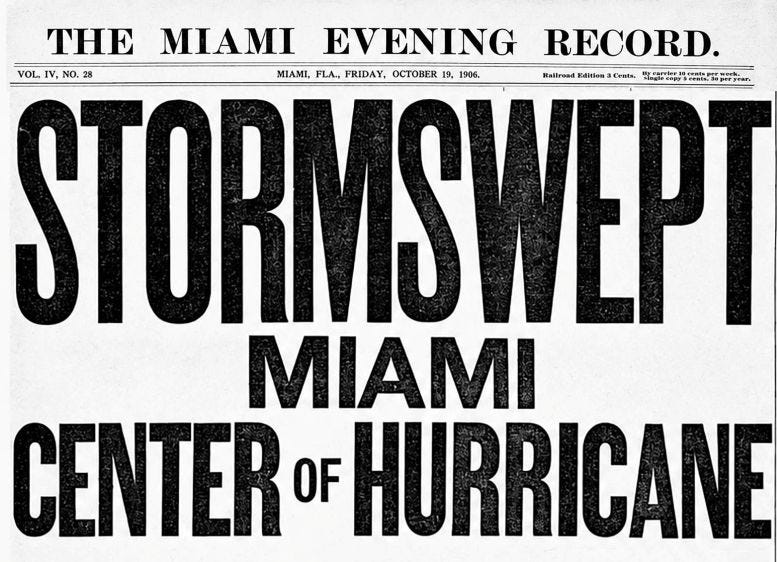
That changed on October 18, 1906, when the most powerful hurricane of the decade struck South Florida. Often referred to as the Florida Keys Hurricane of 1906, the storm crossed the Keys before tracking northeast through the Greater Miami area. With estimated peak winds near 120 miles per hour, the hurricane brought destructive winds and flooding to the young city of Miami.
Streets in downtown Miami were inundated as the storm passed close to the city, while numerous homes, churches, and other buildings, many constructed of wood, were severely damaged or destroyed. The hurricane provided Miami’s growing population with an early and sobering demonstration of the region’s vulnerability to powerful tropical cyclones.
The 1906 hurricane also had a devastating impact on the construction of Henry Flagler’s Over-Sea Railroad, which was then being extended through the Florida Keys toward Key West. Railroad workers were among those caught in the storm, and many of the injured were transported to Miami for medical treatment. During its destructive journey from Central America across Cuba, the Florida Keys, and Southeast Florida, the hurricane claimed approximately 240 lives and caused an estimated $4 million in damage in 1906 dollars.
Although Miami escaped the level of devastation experienced in portions of the Florida Keys, the young city nevertheless suffered significant damage. With the population of the Miami area numbering only about 5,000 people, the destruction of more than 100 homes represented a substantial blow to the fledgling community. Buildings were damaged, streets were flooded, and residents were given a sobering preview of the destructive potential of a powerful hurricane.
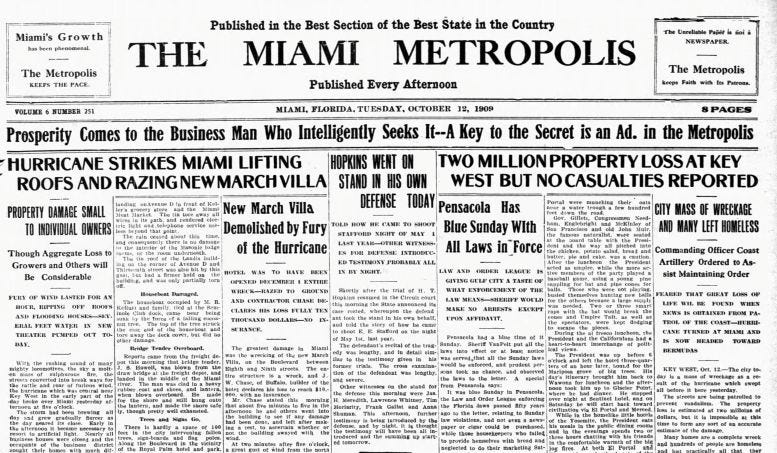
On October 11–12, 1909, a powerful hurricane passed through the Florida Keys before moving northeastward near South Florida. Key West experienced the storm’s most destructive winds, while Miami was struck by strong winds and heavy rain as the hurricane passed nearby. Contemporary reports indicate that the strongest part of the storm remained south of Miami, sparing the young city from the devastation experienced farther south.
Among the most significant damage in downtown Miami was that suffered by the newly constructed March Villa, a planned rooming house located along what is today Biscayne Boulevard and scheduled to open on December 1, 1909. Powerful wind gusts shattered the building’s windows and reportedly lifted the structure from its foundation, leaving it so badly damaged that it had to be razed and rebuilt. The storm also damaged other prominent buildings in the city. According to the October 12 edition of the Miami Metropolis, the Masonic Temple lost its roof during the hurricane.
Miami would continue to experience tropical storms during the following two decades, but it would not confront another major hurricane until the Great Miami Hurricane of 1926. Despite getting a warning in July 1926 of what was to come, no one expected what would be unleashed later in mid-September.

Warning in July 1926
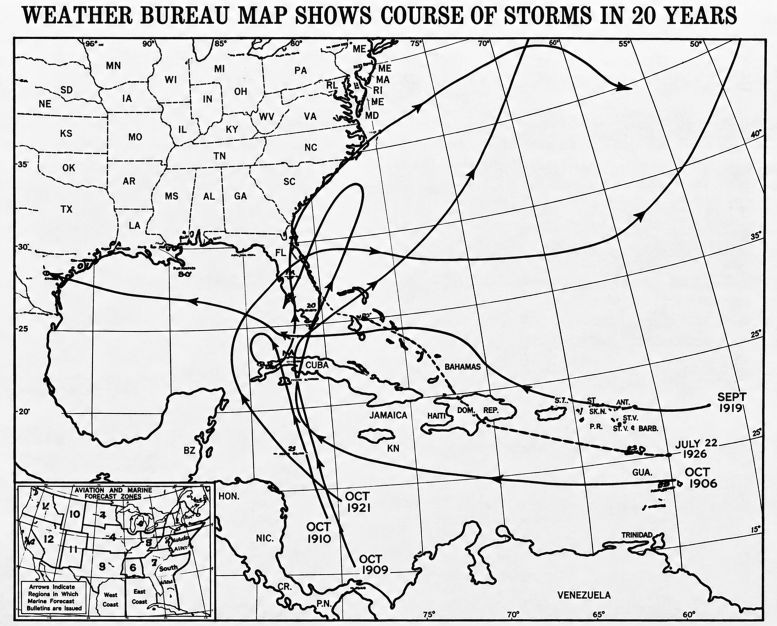
In late July 1926, Miami received a warning of what was to come. A powerful hurricane devastated Nassau before turning northward along Florida’s Atlantic coast. Although the storm’s center remained well to the east of Miami, winds of roughly 55 miles per hour toppled trees, signs, utility lines and telephone poles, while damaging windows and awnings on Miami Beach.
The relatively modest destruction gave many of Miami’s newer residents their first experience with a tropical cyclone. Rather than demonstrating the full danger posed by hurricanes, however, the July storm may have provided a false sense of security. Although the storm could have been much worse had it made a direct hit on Miami, meteorologist Richard Gray, who headed the Miami office of the National Weather Bureau, provided the Miami Herald with a storm activity map over the prior two decades and cautioned Miami residents and visitors to remain vigilant during what was yet to become the peak of the Atlantic hurricane season.
Miami Beach and the coastal communities suffered more than the mainland. Winds shattered windows and tore away awnings, while rough surf and unusually high tides damaged waterfront structures. At North Beach, waves damaged a bulkhead near Baker’s Haulover, and property around the Gulf Stream apartment complex sustained several thousand dollars in wind and water damage. Bulkheads at Normandy Isles were damaged, small palms were uprooted on Allison Island, and several small vessels, houseboats and harbor craft were damaged or wrecked in Biscayne Bay.
Agricultural areas south of Miami also sustained significant losses. Citrus groves were damaged, and contemporary reports estimated that approximately two-thirds of the ripe avocado crop was blown from the trees, representing losses of roughly $100,000 in 1926 dollars.
For Miami residents, however, the most important aspect of the July storm may have been what did not happen. The center remained offshore, so Greater Miami experienced essentially the fringe of a major hurricane rather than its destructive eyewall. The city endured downed utilities, coastal flooding, crop losses and scattered structural damage, but escaped widespread devastation.
Days Prior to Impact
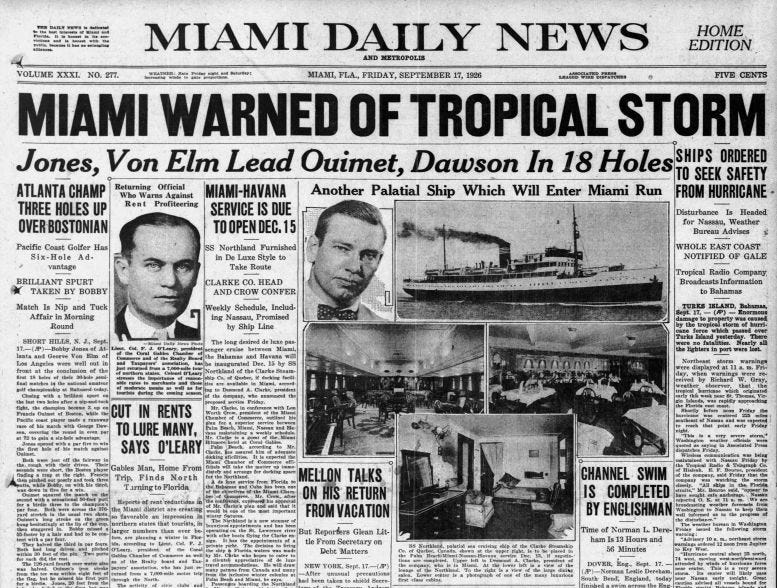
The days leading up to the Great Miami Hurricane of September 18, 1926, were characterized by complacency. Miami had grown so dramatically that the vast majority of its new residents had never had to prepare for a hurricane, much less the storm that was heading their way. Compounding the dangers and feeding the complacency were the limitations of hurricane forecasting during the 1920s. Prediction models by meteorologists relied on ship reports, observations and incomplete communications to track the direction and intensity of storms moving across the Atlantic.
The U.S. Weather Bureau first learned of the developing cyclone through reports from ships in the central Atlantic around September 11. As the storm continued westward, it passed north of Puerto Rico and intensified rapidly, reaching estimated sustained winds of approximately 150 miles per hour near the Turks and Caicos Islands on September 16.
However, forecasters of that era had limited information on the storm’s strength, position and direction. Different from today’s technology, meteorologists did not have satellites, radar, or aircraft reconnaissance to track hurricanes. Even the reports coming from places hit by the storm were intermittent and inconsistent.
By Friday, September 17, the hurricane was tearing through the Bahamas and moving toward South Florida, but Miami still had remarkably little warning. The Weather Bureau had issued no official alert for Miami that morning.
At about noon, Washington authorized the Miami office to hoist a northeast storm warning, indicating dangerous winds but not yet signaling an approaching hurricane. The full hurricane warning did not go up until approximately 11:00 p.m., only a few hours before hurricane-force conditions reached the coast. This left residents less than six hours to prepare, and many people were already asleep when the warning was issued.
While meteorologists were concerned about the track and intensity of the storm by September 17, residents were seemingly oblivious to the danger that was headed their way. As newsboys waved late editions of the Miami Metropolis announcing that a hurricane was headed for Miami, people were shopping, went to picture shows and just went about their business on a pleasant Friday afternoon. Very little hurricane preparedness was happening even hours prior to the impact of this major hurricane.
Landfall on September 18
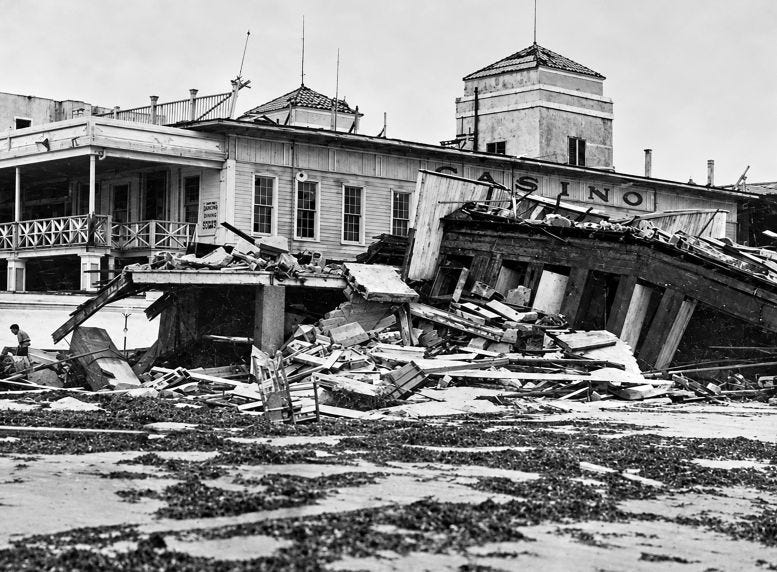
While much of South Florida was still asleep during the early morning hours of Saturday, September 18, the weather began to deteriorate rapidly. By about 1:00 a.m., the outer bands of the hurricane were reaching Miami Beach. Roughly ninety minutes later, the western edge of the storm was battering the barrier island with sustained winds near 60 miles per hour as conditions continued to worsen.
By 3:00 a.m., portions of the region were beginning to lose electrical power and telephone service, leaving many residents increasingly isolated as the hurricane intensified. Within a few hours, sustained winds in downtown Miami exceeded 115 miles per hour. On Miami Beach, an instrument atop Allison Hospital recorded sustained winds of approximately 114 miles per hour before conditions became even more severe.
Although the center of the hurricane crossed the coastline at Miami Beach, more recent NOAA analysis suggest that the center of the eye passed slightly south of downtown Miami. As a result, the heart of the city appears to have remained within the northern portion of the eyewall rather than passing directly through the center of the eye. Around 6:10 a.m., winds in downtown Miami suddenly dropped to about 10 miles per hour, creating a false sense of security that the storm had passed. However, residents were experiencing the eye of the storm, and many were unaware of what was to follow.
As the hurricane-force winds suddenly subsided, many residents of downtown Miami, the most densely populated area in the storm’s path, mistook the lull for the end of the storm. Believing the danger had passed, people emerged from their shelters to inspect the damage to their homes and businesses.
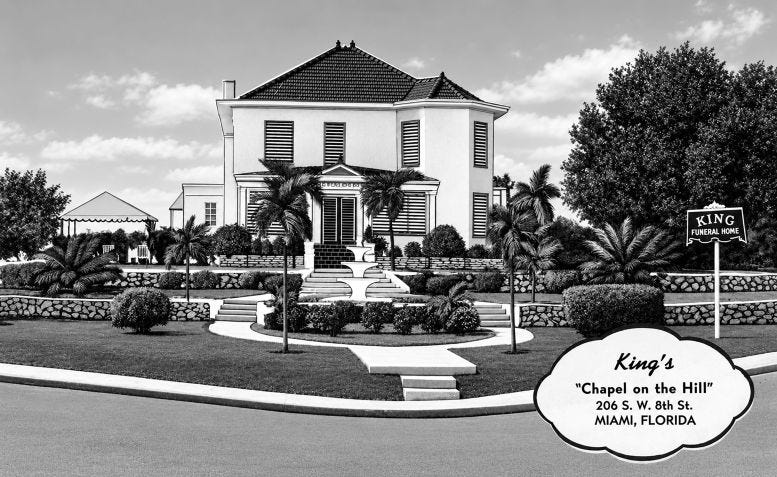
Some who had sought refuge on higher ground, including those sheltered at King’s Funeral Home on SE Eighth Street in Brickell, began making their way back home. At the same time, Miami Beach residents who had evacuated to the mainland started returning across the bay, unaware that the most dangerous portion of the hurricane was still approaching.
From his third-floor post in the Federal Building at 100 NE First Avenue, Richard Gray, meteorologist and official in charge of the Miami Weather Bureau, looked down during the deceptive calm and saw people venturing into the streets. Realizing that many mistakenly believed the hurricane had passed, Gray rushed downstairs and into the street to warn them that the storm was far from over. He urged residents to return indoors and seek shelter before the hurricane’s powerful winds returned. Some heeded his warning and hurried to safety, but others did not.
By about 6:45 a.m., the winds abruptly shifted direction and rapidly increased in intensity as the eastern side of the hurricane swept across the area. People caught in the open suddenly found themselves in extreme danger. Some were crossing the SW Second Avenue bridge between Brickell and downtown, while others were traveling toward Miami Beach along the County Causeway.
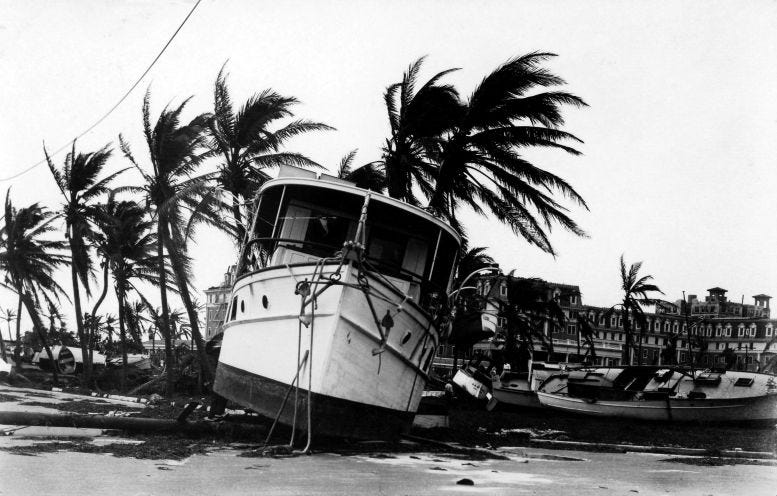
The returning winds were accompanied by a powerful storm surge that pushed water, along with some ships moored in Biscayne Bay, into Bayfront Park and Biscayne Boulevard of downtown Miami, and additional coastal flooding up the Miami River. Those exposed on bridges and along the waterfront had little protection from the rushing water, and some were swept away, contributing to the heavy loss of life during the storm.
My grandmother, Hattie Faye Combs, who lived on SW First Street near the Miami River, recalled losing the roof of their home during this storm. She, her mother and siblings, had to leave their now uninhabitable residence in the middle of the storm by crawling across the street to a neighbor’s house. There were many harrowing stories of survival on that ominous Saturday morning of September 18th.
The back side of the hurricane battered the Miami area for nearly two hours before conditions finally began to improve around 9:00 a.m. As the winds subsided along the southeast coast, the storm continued its destructive march northwestward across the Everglades. By noon, the hurricane was approaching Bonita Springs, and by approximately 3:30 p.m. its center was moving past Punta Rassa and emerging into the Gulf of Mexico. Although the storm had weakened considerably during its passage across the Florida peninsula, it remained a resilient and persistent storm as it entered the Gulf.
The Aftermath
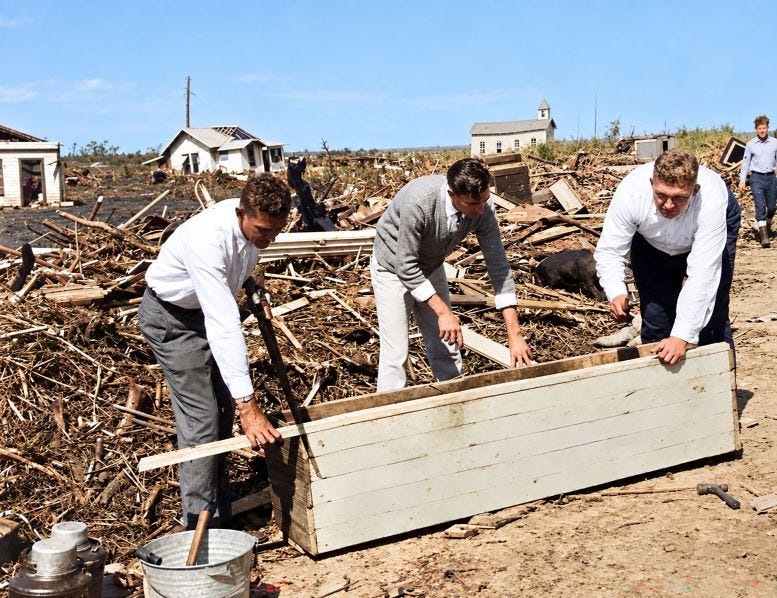
The Great Miami Hurricane of 1926 was both extraordinarily powerful and far-reaching. Hurricane-force winds extended across a broad swath of South Florida, from the Upper Keys northward into southern Palm Beach County. The eye of the storm was estimated to be approximately 13 miles in diameter, while maximum sustained winds reached roughly 145 miles per hour, placing the hurricane within what would today be classified as Category 4 intensity.
The human and physical toll was staggering. The storm claimed an estimated 372 lives, including 114 in Dade County. According to Weather Bureau estimates, approximately 4,725 homes were destroyed and another 9,100 were damaged, leaving more than 25,000 people without adequate shelter.
Miami’s hotels and other commercial buildings became temporary refuges for displaced families. The newly completed Everglades Hotel on Biscayne Boulevard, finished shortly before the hurricane struck, reportedly had to clear sand and water from its lobby before it could be used to house storm victims. In the immediate aftermath, buildings intended to serve tourists and new residents instead became emergency shelters for a city suddenly overwhelmed by destruction.
Contemporary estimates placed the total damage caused by the hurricane at approximately $100 million to $105 million in 1926 dollars, the equivalent of more than $1.8 billion in 2026 dollars. As noted earlier, the City of Miami had a population of roughly 130,000 in 1926, compared with nearly 500,000 residents a century later. With today’s far denser population, vastly greater development, and much higher property values, a hurricane of similar strength following the same path would have the potential to produce economic losses far exceeding those recorded in 1926.
The extent of the destruction varied considerably from one community to another, in part because of differences in construction standards and building codes. For example, Coral Gables, which had emphasized stronger construction during its rapid development in the 1920s, generally fared better than many surrounding communities.
Although homes and commercial buildings suffered broken windows, roof damage, and other moderate losses, much of the city remained structurally intact. Elsewhere across South Florida, however, the destruction was far more severe, particularly in communities where buildings were less substantial or more vulnerable to the hurricane’s powerful winds and storm surge.
Hialeah was one of the hardest-hit communities in the Miami area during the Great Hurricane of 1926. Although further inland, as described in a Miami Herald article:
“Hialeah was subjected to the hurricane’s extreme winds for hours, and its relatively lightly constructed housing stock proved especially vulnerable. Contemporary and later accounts indicate that about 70 percent of the city was severely damaged, with hundreds of working-class homes either flattened or badly damaged.”
Meyer-Kiser Building in Downtown Miami
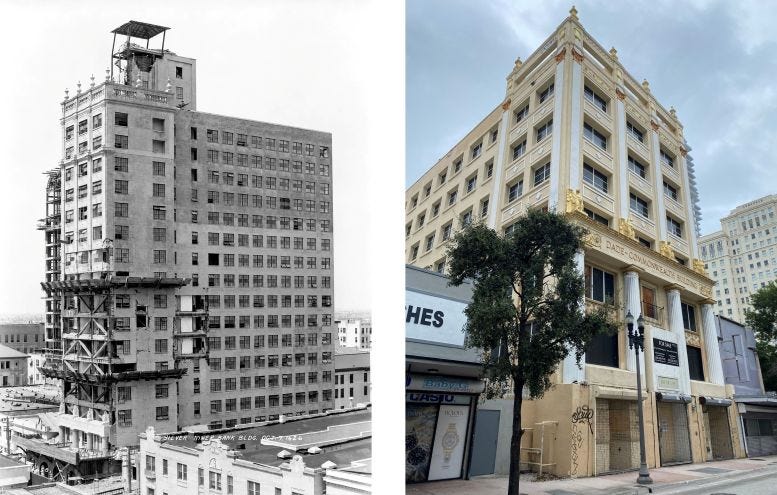
Like many surrounding communities, downtown Miami suffered extensive damage during the hurricane. Powerful winds tore at buildings throughout the business district, while the storm surge pushed schooners, boats, and other vessels onto streets and waterfront property. Floodwaters swept through low-lying areas, inundating ground-floor businesses and leaving portions of downtown covered with debris, mud, and standing water.
Among the most severely damaged structures was the Meyer-Kiser Building at 139 NE First Street. The 17-story office tower, developed by Locke T. Highleyman and Jerry Galatis, had opened only a year earlier in 1925. Its principal tenant was the Meyer-Kiser Bank, a financial institution that specialized in construction financing and mortgages. Founded in Indiana, the company came from a region accustomed to tornadoes and other severe weather and routinely required borrowers to carry insurance against such hazards. That practice would prove especially significant after the hurricane devastated Miami and severely damaged the building that bore the bank’s name.
When Sol Meyer, president of the Meyer-Kiser Bank, agreed to finance the construction of the building, he insisted that developers Locke T. Highleyman and Jerry Galatis obtain insurance protecting the structure against wind damage. After the building opened and the Meyer-Kiser Bank became its principal tenant, Meyer continued to insist that the coverage remain in force. Highleyman and Galatis considered the additional insurance unnecessary. During their years in Miami, the city had not experienced a direct strike from a major hurricane, and there seemed little reason to anticipate such a catastrophe. Nevertheless, they needed both Meyer’s financing and his bank as a tenant, so they maintained the windstorm policy.
That decision proved remarkably fortunate. The Meyer-Kiser Building was reportedly one of only a small number of major downtown structures carrying insurance specifically covering hurricane-force wind damage. Following the storm, structural engineers inspecting the 17-story building determined that hours of exposure to extreme winds had caused its upper floors to twist, leaving them structurally compromised. Engineers recommended that the damaged floors be removed and reconstructed.
Rather than restore the building to its original 17 stories, Highleyman recognized that Miami’s once-booming commercial real estate market was unlikely to recover quickly from the hurricane and the collapse of the building boom. He chose instead to remove the upper ten floors and modify the building to a seven-story structure. The insurance settlement of approximately $675,000 provided sufficient funds to repair and renovate the property. A century after the hurricane, the dramatically altered Meyer-Kiser Building still stands at 139 NE First Street, its seven-story profile serving as a lasting architectural reminder of the destruction wrought by the Great Miami Hurricane of 1926.
An Enduring Legacy
Although the Great Miami Hurricane of 1926 is often credited with bringing an end to South Florida’s extraordinary real estate boom, the collapse was far more complicated. The speculative frenzy had already begun to weaken during 1926 as rising costs, tightening credit, transportation bottlenecks, and declining investor enthusiasm placed growing pressure on the market. The hurricane did not single-handedly end the boom, but it delivered what some historians have described as the “final blow” to a real estate market that had already begun to unravel.
In the storm’s aftermath, Miami’s elected officials and business leaders worked quickly to reassure the outside world and limit the damage to South Florida’s reputation. Even so, confidence in the region as an investment destination weakened as reports and images of the devastation spread.
Many of the era’s most prominent developers remained committed to their projects and continued investing in their communities, often at great personal financial cost. George Merrick, for example, was left holding large numbers of promissory notes from buyers who were unable or unwilling to meet their obligations, contributing to the financial collapse that eventually forced him into bankruptcy. Other leading developers of the boom years faced similar difficulties as the speculative market that had fueled South Florida’s rapid expansion came to an end.
In the aftermath of the hurricane, Miami’s civic and business leaders invested heavily in advertising and public relations in an effort to shape how the disaster was portrayed beyond South Florida. Their message emphasized that the hurricane had dealt the region a serious setback, but Miami would recover quickly and be ready to welcome visitors for the coming winter season. Despite those efforts, tourism declined sharply, mirroring the collapse of the real estate market and deepening the economic difficulties already facing the Greater Miami area.
When the stock market crashed in October 1929, the nation entered the prolonged economic crisis that became the Great Depression. South Florida, however, had already been struggling for several years. The collapse of the real estate boom, the destruction caused by the 1926 hurricane, and the subsequent weakening of tourism had pushed the region into an economic downturn well before the rest of the country. Meaningful recovery would not begin until the mid-1930s, nearly a decade after the hurricane transformed Miami’s fortunes.
The loss of life and economic devastation caused by the Great Miami Hurricane of 1926 left a lasting mark on South Florida. Families mourned loved ones, communities rebuilt shattered neighborhoods, and a region that had expanded at a tremendous pace was forced to confront the consequences of both natural disaster and economic collapse.
A century later, the hurricane remains a defining event in the history of Greater Miami, one that altered the course of its development and tested the people who called it home. Yet amid the destruction and uncertainty, thousands remained, rebuilt their lives and communities, and continued to believe in the future of the Magic City.
Resources:
Website: Hurricane City
Miami Evening Record: “Storm Swept Miami Center of Hurricane”, October 19, 1906.
Miami Metropolis: “Hurricane Strikes Miami Lifting Roofs and Razing New March Villa”, October 12, 1909.
Miami Herald: Weather Bureau Map Shows Course of Storms in 20 Years”, July 29, 1926.
Miami Daily News: “Miami Warned of Tropical Storm”, Friday, September 17, 1926.
Miami Daily News: “Toll of Death Mounting”, September 19, 1926.
Miami Daily News: “Hurricane Hits Miami”, September 19, 1926.
Miami Herald: “75 Are Dead in Miami Storm, 60 Lives Are Taken in Hollywood”, September 20, 1926.