


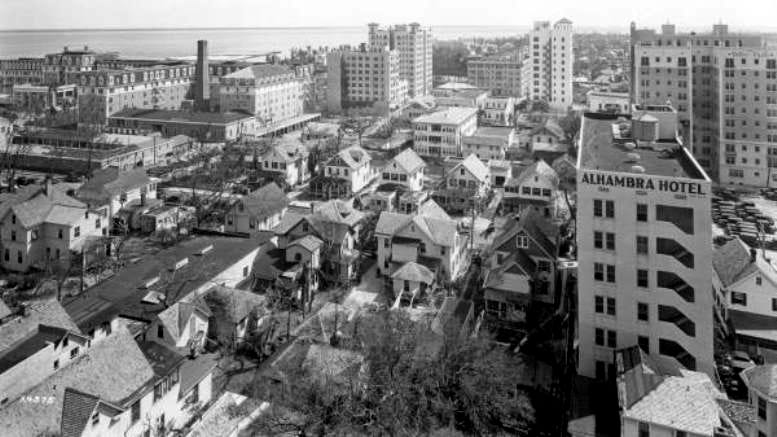
The building boom of the 1920s created unprecedented opportunities in Miami for speculators and developers alike. It was an era when physicians, attorneys, bankers, and even dentists eagerly entered the real estate market, buying and selling property and investing in the construction of new hotels, apartment houses, and commercial buildings as the city grew during this pivotal period.
Among those who diversified their fortunes through part-time development was Dr. David E. Sheehan. Having arrived in Miami in the years following World War I, Sheehan was well positioned to benefit from the explosive growth in new development that defined the early 1920s. He built an apartment house in the burgeoning City of Miami Beach and, at the height of the boom, developed a hotel in the heart of downtown Miami. Opened during the peak years of 1924–1925, the Alhambra Hotel at 119 S.E. Second Street would stand a fixture in the downtown landscape from 1924 until its demolition in 1973.
Dr. David E. Sheehan

A native of Cleveland, Ohio, Dr. David E. Sheehan was an accomplished dentist with a taste for travel. Along with his family, he journeyed extensively through Europe, Asia, and Africa, developing a particular fondness for Cairo, Egypt, where he spent extended periods of time. Those travels, and the contrast they offered to Midwestern winters, ultimately convinced Sheehan to leave Cleveland in favor of a warmer climate.
In July 1918, Sheehan relocated to Miami after purchasing the dental practice of Dr. E. D. Snell, another Ohio transplant who had moved to Miami in 1910 to establish his profession. Snell initially operated from the Watson Building before moving his office in 1914 to the Red Cross Pharmacy in the Townley Building. After acquiring the practice, Dr. Sheehan continued to operate his dental office from that same location, building upon the goodwill established by his predecessor.
By 1922, Dr. David E. Sheehan had risen to prominence within both his profession and the broader Miami community. That year he was elected president of the Florida State Dental Association and chosen to lead the Miami Civitan Club, a civic organization devoted to charitable work. During his tenure, Sheehan introduced the club’s enduring slogan, “Miami is the place where the summer spends the winter,” a phrase that neatly captured the city’s growing national appeal.
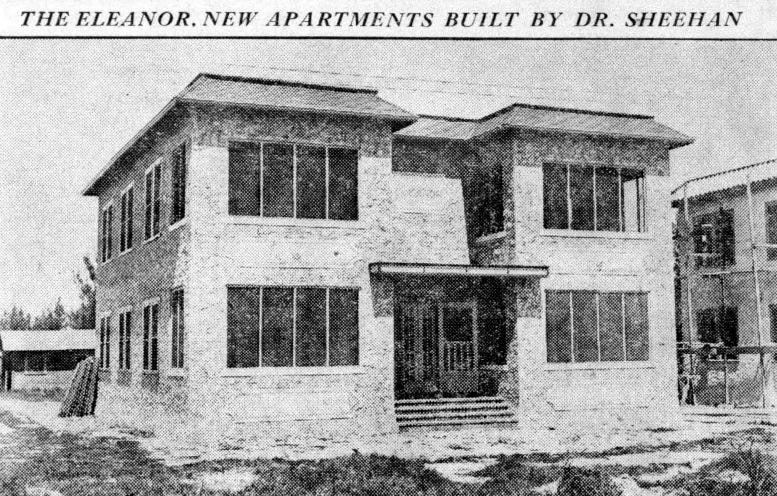
That same year marked Sheehan’s first step into real estate development. He purchased a parcel at the corner of Washington Avenue and First Street in Miami Beach, where he constructed an apartment building he named The Eleanor in honor of his wife. The Sheehan family briefly took up residence on the beach, but it was not long before Dr. Sheehan set sights on a more ambitious project in the heart of downtown Miami.
Construction of the Alhambra Hotel
Dr. Sheehan acquired a parcel on the north side of S.E. Second Street, midway between S.E. First and S.E. Second avenues. Measuring fifty feet in width and one hundred fifty feet in depth, the lot offered an ideal footprint for a substantial downtown structure. On December 22, 1923, the Miami Herald and the Daily News announced Sheehan’s plans to erect a seven-story hotel on the site, with completion projected for the fall of 1924. He commissioned architects L. P. Robertson and L. R. Patterson to design a Spanish-themed building accented with Moorish influences which he named the Alhambra Hotel, to pay homage to a favorite architectural style he enjoyed during his travels overseas.
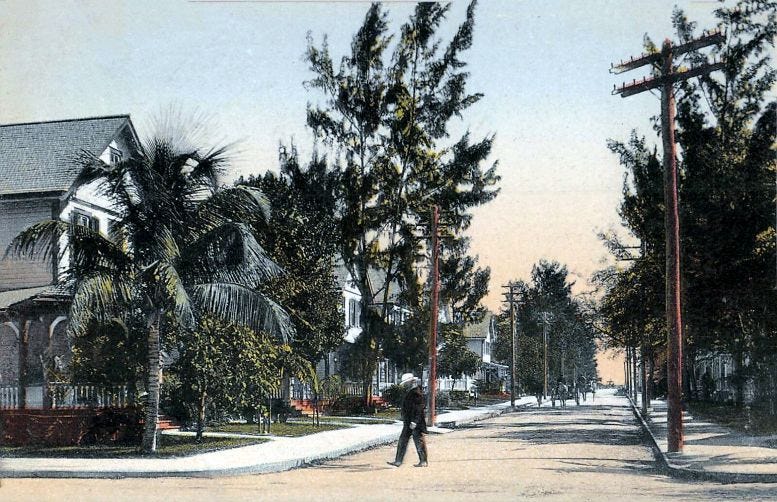
Prior to the announcement of Sheehan’s new hotel, S.E. Second Street remained largely part of the Flagler Cottage residential enclave adjacent to Royal Palm Park. However, in 1922, attorney turned developer Frederic Rand transformed the east side of S.E. First Avenue, between S.E. First and S.E. Second streets, with the construction of the Columbia Building, a two-story arcade housing shops, restaurants, and offices. When the Alhambra Hotel opened in late 1924, it rose alongside the Columbia Building, signaling the district’s transition from a quiet residential quarter to a bustling commercial corridor.
Sheehan engaged P. J. Davis Construction as the general contractor for the project, with work officially commencing in late March 1924, which was later than originally anticipated when the hotel was first announced. The delayed start, combined with unforeseen construction setbacks, pushed completion beyond the projected October 1 deadline and into early December. The Alhambra Hotel began quietly welcoming guests on December 11, while preparations continued for its formal grand opening on Saturday, December 20, 1924. The Sheehan family moved from Miami Beach to their completed five-bedroom apartment in the hotel.
Formal Opening of the Inn
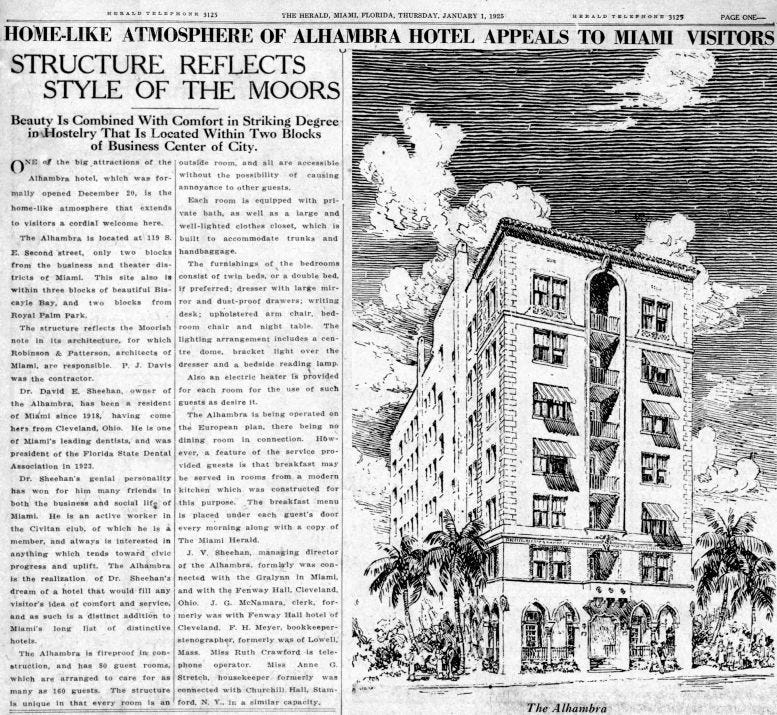
On the evening of Saturday, December 20, 1924, friends, dignitaries, and invited guests were welcomed to explore Miami’s newest downtown landmark, a seven-story hotel newly opened to the public. Approaching the entrance, visitors would have immediately noticed the building’s relatively narrow street frontage contrasted with its deep footprint on the lot, measuring thirty-eight feet wide and extending one hundred twenty feet to the rear. In keeping with the ceremonial flair typical of the era, Dr. Sheehan marked the occasion with music, engaging George Jackson’s Orchestra to provide entertainment throughout the grand opening festivities.
Guests ascended a short flight of steps from the street into a loggia measuring thirty-eight feet in width and thirteen feet in depth, which led directly into the hotel’s main lobby, a parlor twenty feet wide and thirty-six feet deep. There, they were greeted by members of the Sheehan family and invited to tour the building. The family’s private five-bedroom apartment occupied part of the ground floor behind the front desk and hotel offices. Both the loggia and lobby were finished with terrazzo floors, while the lobby itself was distinguished by an ornamental Spanish ceiling and a large open stone fireplace, lending the space an air of warmth and Old World elegance.
The building was constructed with a full basement, housing mechanical equipment, employee quarters, and ample storage space. A modern high-speed elevator served the hotel, running from the basement to the uppermost floor. The top six stories contained eighty-five guest rooms, each level featuring a balcony with iron railings, at the southern end of the floor, overlooking S.E. Second Street.
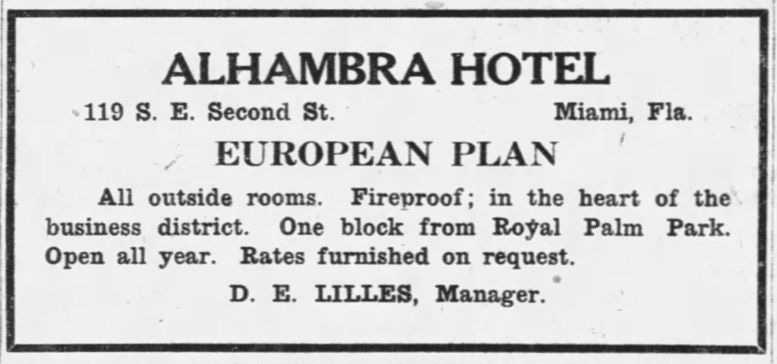
Upon opening, Dr. Sheehan appointed his son, J. V. Sheehan, as manager of the hotel. The younger Sheehan brought considerable experience to the position, having previously managed the Gralynn Hotel, located just one block west of the Alhambra, as well as Fenway Hall in Cleveland, Ohio.
Promotional materials emphasized the hotel’s convenient location, only two blocks from Miami’s business and theater district and within three blocks of Biscayne Bay and Royal Palm Park. Like many hotels of the era, the Alhambra operated on the European plan, a standard disclosure indicating that no dining room or restaurant was maintained on the premises.
