

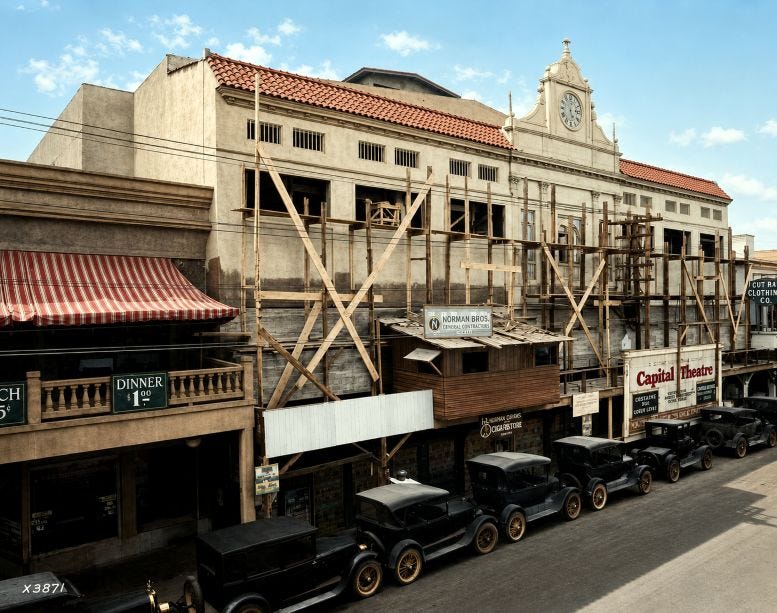
When Mitchell Wolfson and Sidney Meyer established the Wolfson-Meyer Theatre Company in 1925, they envisioned a modern, cutting-edge venue for downtown Miami. They chose a prominent site along one of the city’s main thoroughfares to construct The Capitol Theatre at 310 North Miami Avenue which would be the centerpiece of the organization’s entertainment district for decades to follow.
Designed as an upscale “first-run” house, the theater was meant to showcase the finest films available at the time. It would also introduce a feature that few Miami residents would experience in their own homes until decades later, air conditioning, which underscored the venue’s emphasis on comfort and innovation.
Built During the Boom
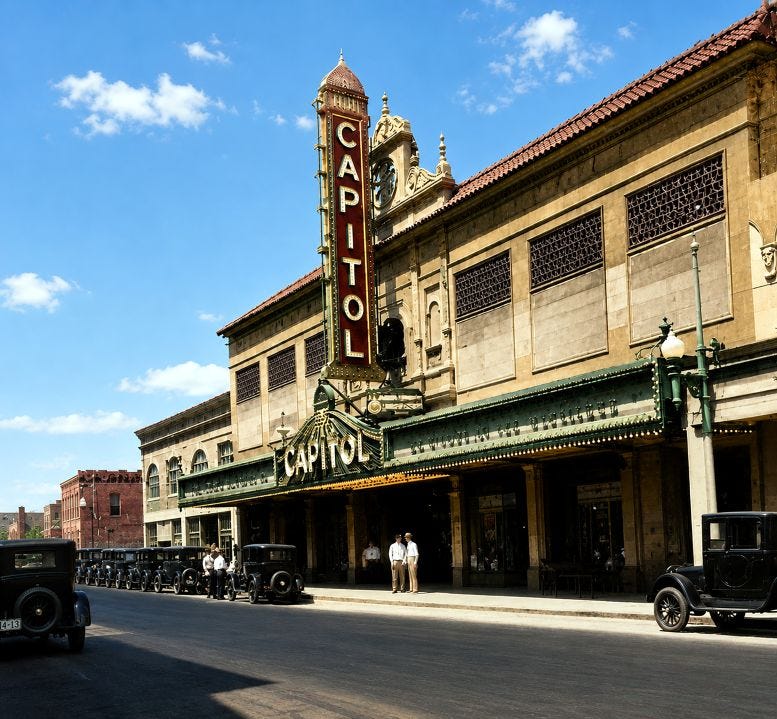
The Capitol Theatre was designed by architect E. T. Wells in a Spanish-influenced style. Construction was awarded to the S. S. Jacobs Company of Omaha, a choice likely influenced by Sidney Meyer, who was raised in Omaha and educated at the University of Nebraska.
Although the mid-1920s building boom fueled unbridled growth across Miami, it also created intense competition for materials and labor. Construction began in 1925 but quickly fell behind schedule as shortages slowed progress. By late that year, both supplies and skilled workers were scarce, forcing the contractor to bring in additional labor from outside the region. Despite these challenges, the theater was completed by the summer of 1926 at a cost of $300,000.
Inside, the Capitol Theatre was a richly decorated interior, featuring an intricate mosaic floor and an impressive chandelier. Its color palette of orange, ivory, gold, and green, evoked the hues of a tropical sunset. The spacious interior included a main floor, balcony, and orchestra seating, blending the grandeur of the Gilded Age with a distinctly South Florida flair.
One of the building’s most innovative features was its early form of air conditioning. Large fans circulated air that had been cooled by passing through a fine spray of ice water, maintaining a steady temperature of 70 degrees. On opening night, which occurred during the peak of the summer, this system provided a welcome relief from Miami’s heat, offering patrons a level of comfort few had ever experienced.
Opening Night of the Capitol Theatre
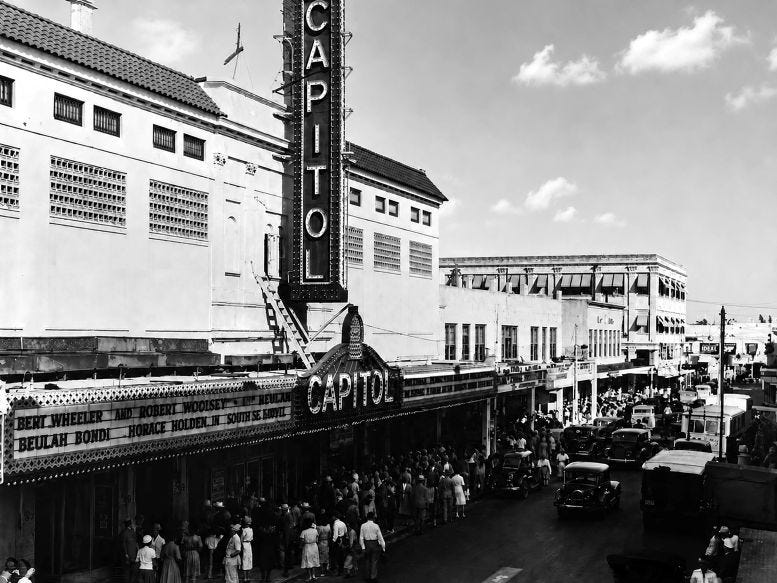
The Capitol Theatre officially opened on the evening of June 25, 1926, welcoming 1,500 invited guests on a typical warm June night in Miami. The newly installed ventilation system proved immediately popular, providing welcome relief from the heat. According to the following day’s Miami Herald, several hundred additional people were turned away from the sold-out grand opening.
In contrast to modern premieres, theater openings in this era were major social events, often structured as full evening programs of entertainment. The Capitol’s debut reflected that tradition. The audience was first greeted by Mr. James Donn, followed by Seigbert Asher, who performed a rendition of “The Volga Boatman.” Miss Evelyn Brown, billed as a “danseuse,” then took the stage before a newsreel was shown to the audience.
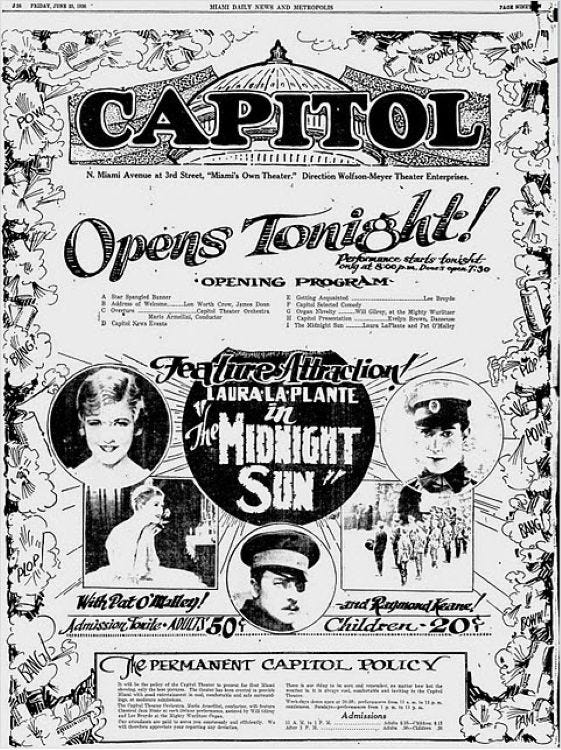
The evening concluded with the feature presentation, a Universal Pictures production titled The Midnight Sun, a drama set in Russia during the time of the Czars.
Many years later, Mitchell Wolfson recalled that the true highlight of the night was the performance by the Capitol Theatre Orchestra. Under the direction of Mario Armellini, former musical director of the Roney Plaza, Royal Poinciana, and Breakers hotels, the orchestra earned a standing ovation from the audience. From that opening night forward, the Capitol Theatre Orchestra became a beloved fixture among Miami theatergoers.
