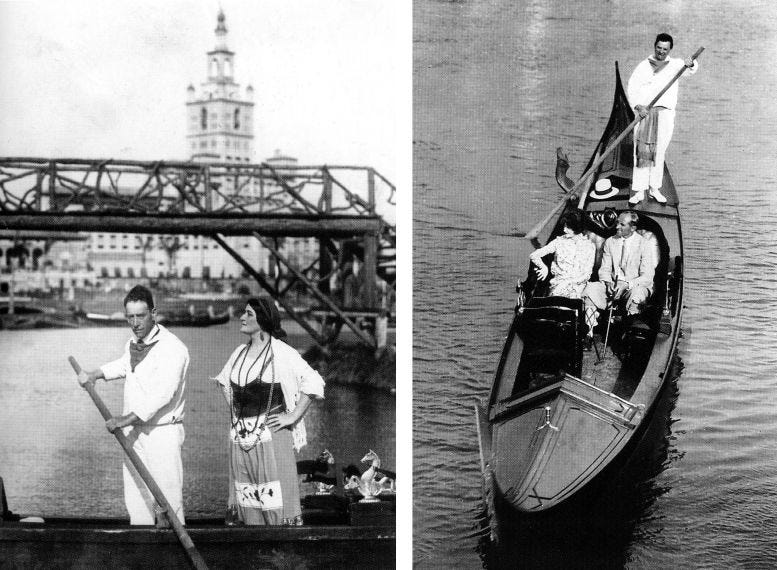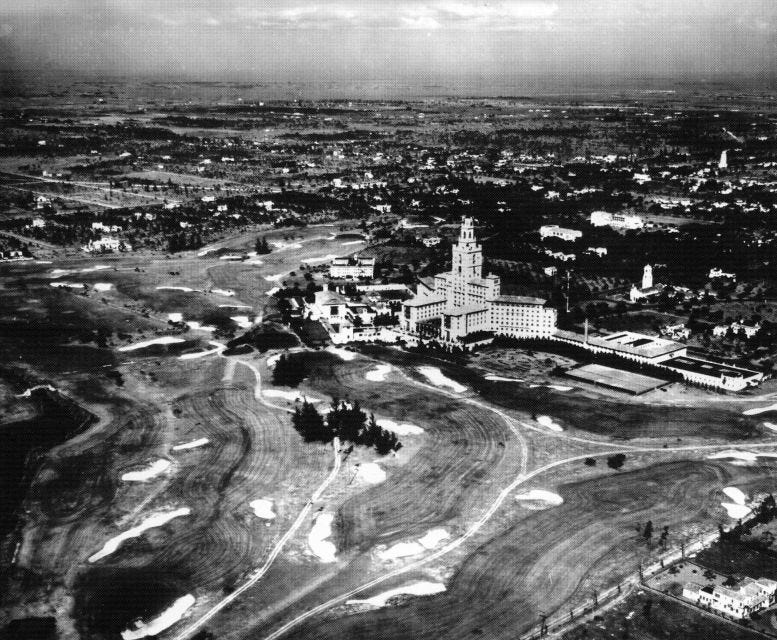
As much of the world endured unseasonably cold weather, thousands of travelers set their sights on subtropical South Florida, drawn by the completion of one of Coral Gables’ crown jewels. After more than ten months of construction and an investment of ten million dollars, the Miami-Biltmore Hotel, as it was known in 1926, stood ready to mark its grand opening with an unforgettable celebration.
The inn was the result of a partnership between city founder George Merrick and John McEntee Bowman, president of the international Biltmore chain of luxury hotels. Bowman was renowned for staging lavish opening celebrations, spectacles that were attractions and drew thousands of devoted followers known as “caravansaries.”
This is the story of the formal grand opening celebration that began on Friday, January 15, 1926, and lasted the entire weekend. While the Miami-Biltmore Hotel had its trials and tribulations after its opening, for one weekend, the newest addition to both Coral Gables and the Bowman-Biltmore Company was the bell of the ball.
Tribute to a Great Enterprise
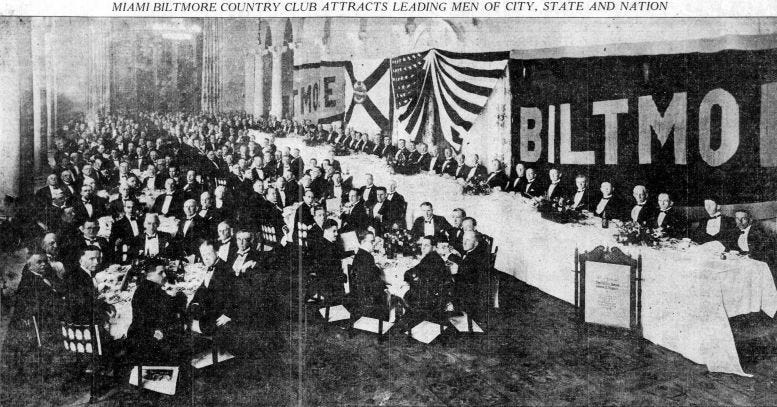
On the evening of Thursday, January 14, 1926, the night before the hotel’s official opening, dignitaries from across the nation assembled to honor the vision and execution of the two men behind the grand hostelry. Formally attired guests gathered in the Great Room of the Miami-Biltmore Country Club to celebrate the achievements of John McEntee Bowman and George Merrick. The evening served both as an ovation for the two principals and a tribute to their success in bringing the elegance and ambition of the Miami-Biltmore Hotel and Country Club to Coral Gables and the greater Miami area.
The country club ballroom was adorned with an assortment of flags, including the national and state ensign, to commemorate an establishment that was both an American and Florida institution. As described in the book ‘The Biltmore Hotel, An Enduring Legacy,’ the Thursday night’s event commenced with a “triumphant march performed by the Westchester-Biltmore Orchestra as guests took their places amidst the lines of tables with their shining silver, gleaming napery and distinctive dinnerware.” This was a very formal tribute to the hard work that culminated in the hotel and country club.
George Merrick got emotional as he reflected on his vision and the hard work that had gone into designing and building of Coral Gables. He paused and deferred credit to others, especially the influence of his father, the Reverend Soloman Merrick, who he credited with providing him the foundation to help guide the development of the City Beautiful.
The guest list for this exclusive evening read like a who’s who of Miami’s civic, political, and business leadership. Among those in attendance was James M. Cox, former governor of Ohio, presidential candidate, and publisher of the Miami Daily News. Also present were Lon Worth Crow, president of the Miami Chamber of Commerce; E. E. “Doc” Dammers, noted real estate promoter and the first mayor of Coral Gables; and Frank B. Shutts, publisher of the Miami Herald. Additional distinguished guests included Miami Mayor Edward C. Romfh and Glenn H. Curtiss, aviation pioneer and developer of Miami Springs, Hialeah, and Opa-locka.
One notable toast was from the general contractor of the hotel, John B. Orr, who introduced Merrick and Bowman, when he stated, “we are fortunate in having men of imagination in our midst who can transform the drab into things of grandeur and poetry, and they have wrought no greater achievement than we are witnessing tonight.”
The evening was punctuated by hundreds of toasts, accompanied by an exquisite dinner prepared by Chef Durand, whose culinary talents had served nobility and presidents alike. Yet as remarkable as the night proved to be, it was merely a prelude to a weekend that would unfold with even greater opulence, elegance, grandeur, and pomp.
A Destination Celebration
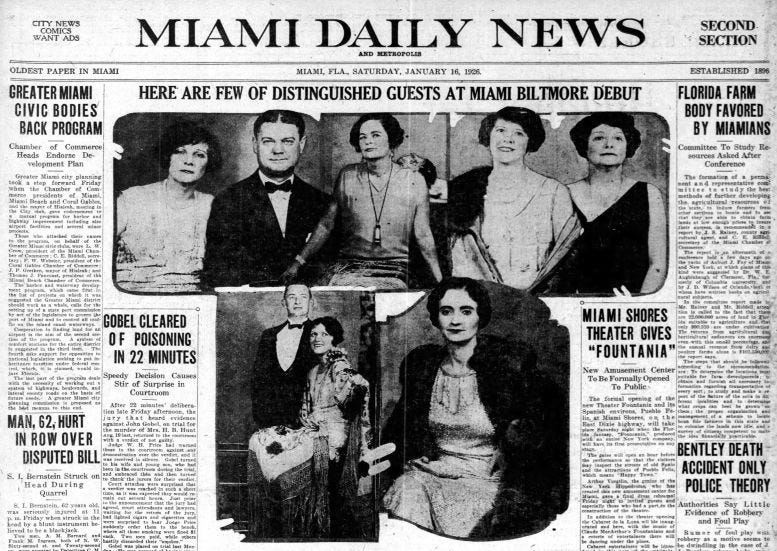
As reviews of the Miami-Biltmore Hotel appeared in publications across the country, it was hailed as “the finest of the Biltmore inns.” Writers praised it as the hotel Florida needed, applauding the carefully curated Italian and Spanish furnishings that infused the property with an unmistakable Old World atmosphere.
When the opening date was announced and details of the grand celebration were revealed, demand for invitations to the Friday night banquet surged. More than 5,000 requests poured in, yet only 1,500 invitations could be issued, limited by the capacity of the seating area and by the elaborate programming that required ample space for performers to move among the tables and across the dance floor.
Journalists offered lavish praise for the hotel’s loggia and the richly detailed interiors of its main level, marveling at the building’s elaborate and vintage design. As noted by the authors of The Biltmore Hotel: An Enduring Legacy, the Miami-Biltmore defied easy categorization, blending influences described as “Spanish, Italian, Persian, Egyptian, Moorish, and even ultra-Mediterranean.” Drawing inspiration from sixteenth- and seventeenth-century Italian palazzos and Spanish castles, these varied traditions came together to create interiors of remarkable grandeur.
Guests fortunate enough to receive invitations traveled from across the country to attend the celebration. Local dignitaries were joined by attendees arriving from New York, Chicago, and other northern cities. Hundreds of New Yorkers made the journey aboard two specially arranged trains, one traveling along the Atlantic Coast Line tracks and the other via the Seaboard Air Line Railway. Regardless of the route, passengers were treated to the refined comforts and luxuries reserved for the era’s elite.
Departing Pennsylvania Station in the early evening of Wednesday, January 13, 1926, the trains arrived in Miami on Friday morning, allowing guests time to rest before the grand opening festivities began. The journey set a record, covering the distance in just 36 hours and 20 minutes. Once settled in South Florida, out-of-town guests found themselves only hours away from a long-anticipated and spectacular celebration.
Gondolas & Gondoliers