

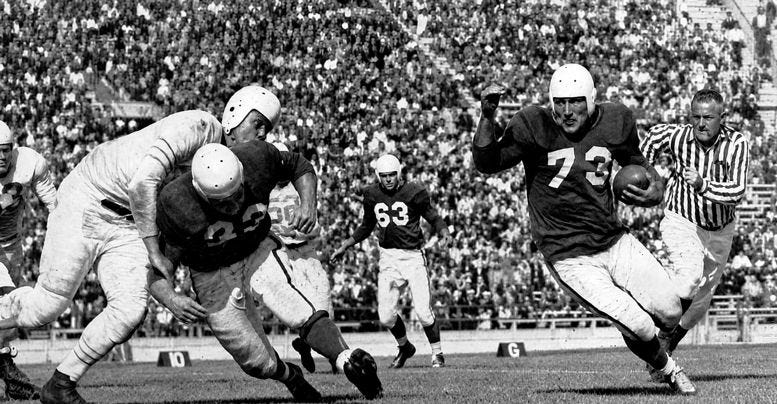
As the Miami Dolphins approach the start of their 60th season, it should be noted that the Dolphins were not the first professional football team in Miami. The Dolphins first season began in 1966, but it was 20 years earlier that the Miami Seahawks played their one and only season in Miami as part of the All American Football Conference (AAFC).
Although the All-America Football Conference (AAFC) may be unfamiliar to many football fans today, it posed a serious challenge to the established NFL during the postwar years of the late 1940s. When the AAFC folded after the 1949 season, several of its franchises were absorbed into the NFL in 1950.
Among them were the Cleveland Browns and San Francisco 49ers, two teams that remain prominent NFL franchises today. The original Buffalo Bills also competed in the AAFC before the name was later revived by a new franchise in the American Football League in 1960. The Miami Seahawks, however, followed a very different path, one that ultimately created an intriguing historical connection to today’s Indianapolis Colts.
All American Football Conference
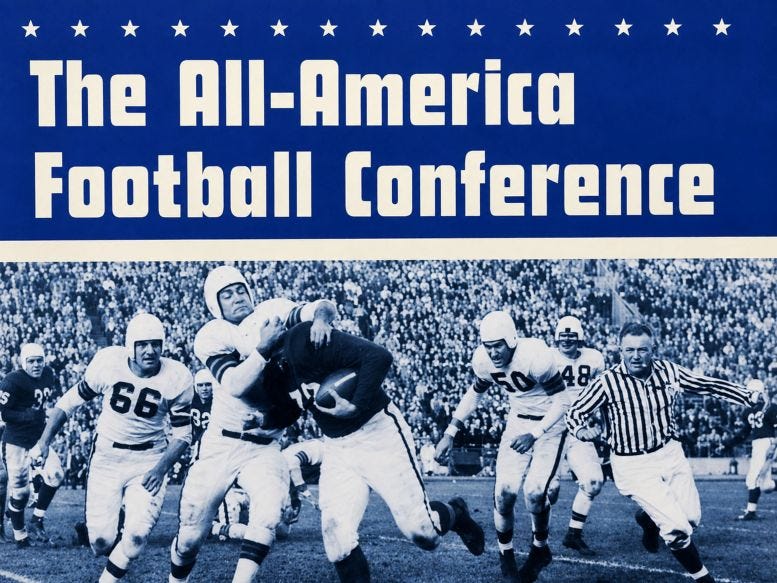
As the end of World War II came into view, wealthy investors across the United States began looking ahead to the opportunities of the postwar era. By 1944, the National Football League had been in existence for nearly a quarter century and appeared poised to resume its role as a monopoly in professional football once the war ended.
At the same time, a growing number of wealthy businessmen wanted an opportunity to enter the professional football market. Many of the NFL’s established owners, however, resisted expansion, believing that adding new franchises would divide fan interest and reduce the earning potential of existing teams. Their refusal to expand left prospective owners with few options for joining the league. Rather than abandon their ambitions, some of these investors chose another path, one that would ultimately lead to the creation of rival professional football leagues.
One organization was particularly well positioned to challenge the NFL’s established standing. The All-America Football Conference (AAFC) was founded by Chicago Tribune sports editor Arch Ward and formally introduced on September 2, 1944. Ward was already a prominent figure in American sports, having originated the Major League Baseball and college football All-Star games.
Drawing on his extensive connections in the sports world, he assembled a group of wealthy football enthusiasts willing to finance and operate franchises in the new league. With substantial financial backing and access to major media outlets, the AAFC entered the professional football landscape with the resources and visibility necessary to pose a serious challenge to the NFL.
On November 21, 1944, Ward hired Jim Crowley to serve as commissioner of the new league. Crowley brought considerable football prestige to the position as one of the legendary “Four Horsemen of Notre Dame,” who played under famed coach Knute Rockne. In an interesting twist, the NFL commissioner at the time was Elmer Layden, another member of Rockne’s celebrated Four Horsemen. The two rival professional football leagues were therefore headed by former Notre Dame teammates who now found themselves competing for players, fans, and media attention in the rapidly changing postwar sports landscape.
The new league quickly assembled six franchises including: Buffalo, Chicago, Cleveland, Los Angeles, New York and San Francisco. The Cleveland franchise hired as their first head coach, Paul Brown who had coached Massillon High School in Ohio to six championships in nine years and led Ohio State to the 1942 National Championship. Paul Brown’s innovations would not only impact the excitement of the game played in the AAFC, but led to changes in the NFL that help guide the evolution of the game to what it is today.
Brooklyn would later be added as the seventh franchise. The league had hoped to add Baltimore as the eighth franchise. Baltimore’s ownership group was headed by retired boxer, Gene Tunney, and the group was considered well-funded and well positioned to round out the original set of franchises. However, Baltimore was unable to get an agreement with Municipal Stadium in time to be awarded a franchise.
The AAFC needed to add one more team to have a properly balanced league. In addition to Baltimore, there were several other cities that were competing for the last franchise. However, it was an unexpected candidate that ultimately got the eighth and final franchise for the inaugural season.
Miami Awarded AAFC Franchise
At an AAFC ownership meeting on December 8, 1944, the league awarded its eighth and final franchise to Miami. Two days later, the Miami News reported that the franchise had been acquired by Harvey Hester and his partner, Doug Wycoff, a former football star at Georgia Tech. Hester explained that “he and Wycoff were the principal men involved right now, but they were hoping to include some of Miami’s business leaders in the venture.” Their successful bid brought Miami into the new professional football league ahead of four other cities that had also been competing for the final franchise.
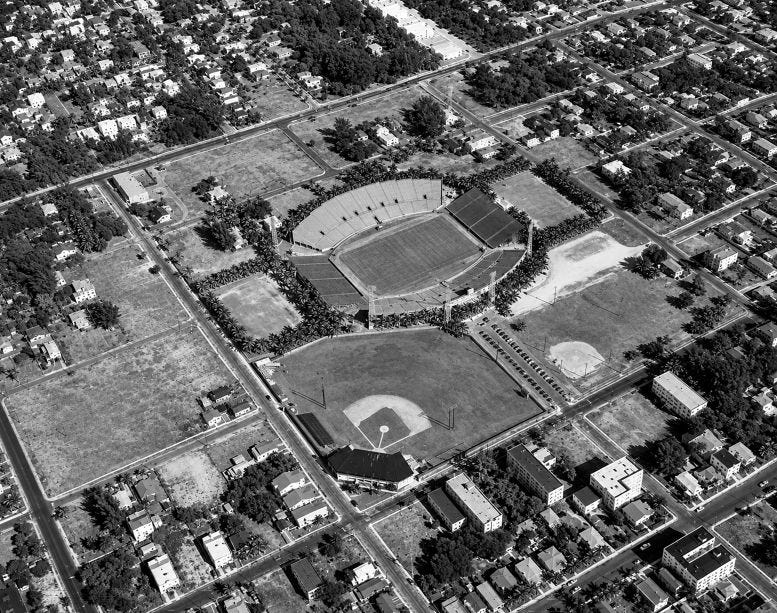
The announcement generated considerable excitement in Miami, which was preparing to welcome a major professional football team for the first time. The new franchise adopted the name of the Miami Seahawks and secured an agreement to play its home games at Roddey Burdine Stadium. The stadium, already one of Miami’s most important sporting venues, would later become known as the Orange Bowl. With a name, ownership group, and home field in place, the Seahawks were positioned to represent Miami when the AAFC began play.
Harvey Hester was an Atlanta restaurateur who also maintained business interests in Miami. Compared with the other owners in the newly formed AAFC, however, Hester had relatively modest financial resources. In fact, he was the only franchise owner in the league who was not a millionaire, a distinction that would become increasingly important as the Seahawks attempted to compete with better-financed teams.
Hester quickly went to work assembling his football organization and hired Jack Meagher as the Seahawks’ first head coach. Like AAFC commissioner Jim Crowley, Meagher had ties to Notre Dame, where he played in 1916 under then-assistant coach Knute Rockne as a backup tight end. He later served in the U.S. Marines during World War I and played for the Chicago Tigers during the American Professional Football Association’s (APFA), inaugural season in 1920. The Tigers only lasted one season in the APFA which was later renamed to the National Football League in 1922. Meagher went on to build an extensive coaching résumé that included stops at Rice University and the Iowa Pre-Flight Seahawks before taking charge of Miami’s new professional football team.
The Seahawks also assembled an experienced group of assistant coaches. Hamp Pool, a standout player at Stanford who later played professionally for the Chicago Bears, was hired to coach the backfield. Hank Crisp, who had spent 25 years coaching highly regarded lines at the University of Alabama, was brought in as the Seahawks’ line coach. Together, Meagher, Pool, and Crisp gave the fledgling Miami franchise a coaching staff with extensive experience in both college and professional football.
By December 1945, the Miami Seahawks’ roster was beginning to take shape. In its December 13 edition, The Miami News reported that owner Harvey Hester believed he had a legitimate chance to persuade Sid Luckman, the celebrated quarterback of the Chicago Bears, to come to Miami. Luckman ultimately remained with Chicago and went on to lead the Bears to their fifth NFL championship in 1946.
The AAFC understood that attracting top players away from the established NFL would require aggressive spending. New league owners often offered substantially higher salaries to proven veterans and sought-after draft choices, a strategy that angered longtime NFL owners such as George Halas. The competition forced NFL teams to respond financially, either by increasing what they were willing to pay their players and prospects or risk losing them to the rival league.
By the time the Seahawks reported for their first training camp, Hester was optimistic about the roster and coaching staff he had assembled. That confidence was shared by many in South Florida, where excitement was building around the arrival of a professional football team representing Miami on a national stage.
One and Only Season in 1946
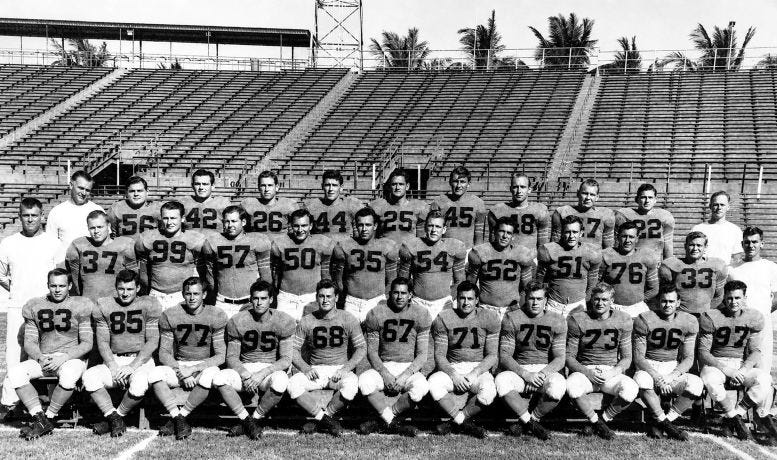
The All-America Football Conference structured its inaugural-season schedule in part around the expected weather conditions in each city. Buffalo, for example, was given a schedule that placed more of its home games early in the season, reducing the likelihood that the team would have to play too many late-season contests in snow and bitter cold.
Miami faced the opposite situation. Because of South Florida’s heat and humidity during the early fall, the Seahawks opened the season with three consecutive road games and were scheduled to play seven of their first eight contests away from home. Although Miami residents were eager to see the city’s first professional sports franchise in action, they would have only one opportunity to watch the Seahawks at home before the middle of November 1946.
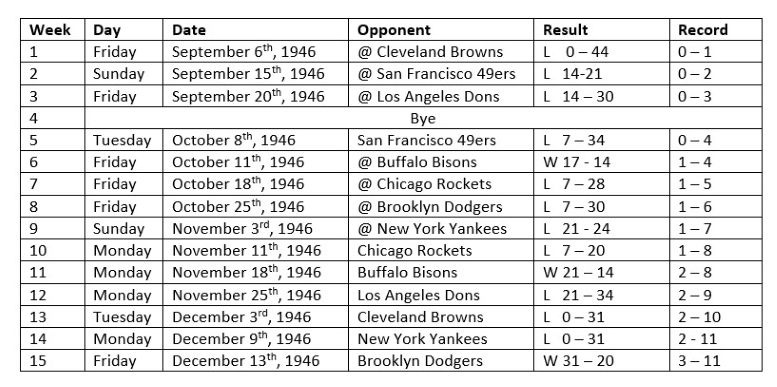
The difficult schedule did little to help the expansion team find its footing. Miami opened against the Cleveland Browns, followed by games against the San Francisco 49ers and Los Angeles Dons. The Seahawks lost all three contests by a combined score of 95–28. After the third defeat, one local newspaper columnist offered a particularly harsh assessment of the struggling team, describing the Seahawks as “woefully inept.”
The Seahawks arrived at Roddy Burdine Stadium for their first home game carrying a 0–3 record. On Tuesday, October 8, 1946, Miami suffered its fourth consecutive defeat, losing to the San Francisco 49ers by a score of 34–7 before a crowd of approximately 7,500 fans. The early losing streak quickly began to erode some of the enthusiasm that had surrounded the arrival of professional football in Miami. Following the disappointing home debut, the Seahawks returned to the road for three consecutive Friday night games.
Their next stop was Buffalo on October 11, 1946, where the Seahawks finally earned the first victory in franchise history by defeating the Bisons, 17–14. The celebration was short-lived. One week later, Miami traveled to Chicago and lost to the Rockets, 28–7. The defeat dropped the Seahawks to 1–5 on the season and underscored just how difficult their inaugural campaign had become.
The Seahawks’ difficult start eventually led to a change in leadership. On October 22, 1946, head coach Jack Meagher abruptly resigned. His departure came as little surprise, and the team’s Board of Directors quickly accepted his resignation. Team president Harvey Hester announced that assistant coaches Hamp Pool and Hank Crisp would jointly direct the Seahawks for the remainder of the season, expressing confidence in the abilities of both men. Hester also acknowledged problems with the construction of the roster, stating, “I was misinformed about players I signed and that there would be changes made.”
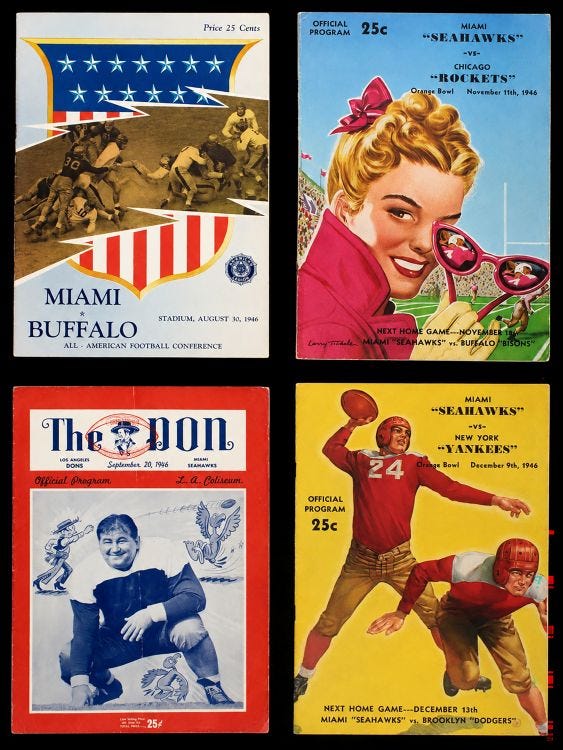
Pool and Crisp had little time to make those changes before their first game in charge. Just three nights later, the Seahawks traveled to Brooklyn to face the Dodgers. Unfortunately, the coaching change did little to alter Miami’s fortunes. Brooklyn defeated the Seahawks decisively, 30–7, extending what had already become a frustrating season.
Following the loss in Brooklyn, the Seahawks finally returned to Miami for an extended stretch of home games. They opened a six-game homestand with three consecutive Monday night contests at Roddy Burdine Stadium. It marked the first time a professional football team had played more than one home game on Monday night during a season. The unusual scheduling arrangement provided an early precedent for the concept of Monday night football, an idea that the NFL would adopt many years later.
The Seahawks lost two of their three consecutive Monday night games, but they did manage to defeat the Buffalo Bisons for a second time, completing a season sweep of their northern rival. It is an accomplishment that Miami Dolphins fans would undoubtedly enjoy seeing repeated against Buffalo today.
Miami then dropped its next two home games before giving local fans something to celebrate in the season finale. The Seahawks closed their inaugural campaign with a 31–20 victory over the Los Angeles Dons at Roddy Burdine Stadium, ending an otherwise difficult season on a positive note.
The 1946 season proved to be a frustrating one for owner Harvey Hester, and his troubles did not end when the final whistle sounded. After leaving Roddy Burdine Stadium following the last game of the season, Hester was involved in an automobile accident. The Miami News reported on December 16 that the accident was minor and resulted in no injuries, although Hester’s car sustained significant damage. He was subsequently charged with reckless driving.
Save the Miami Seahawks
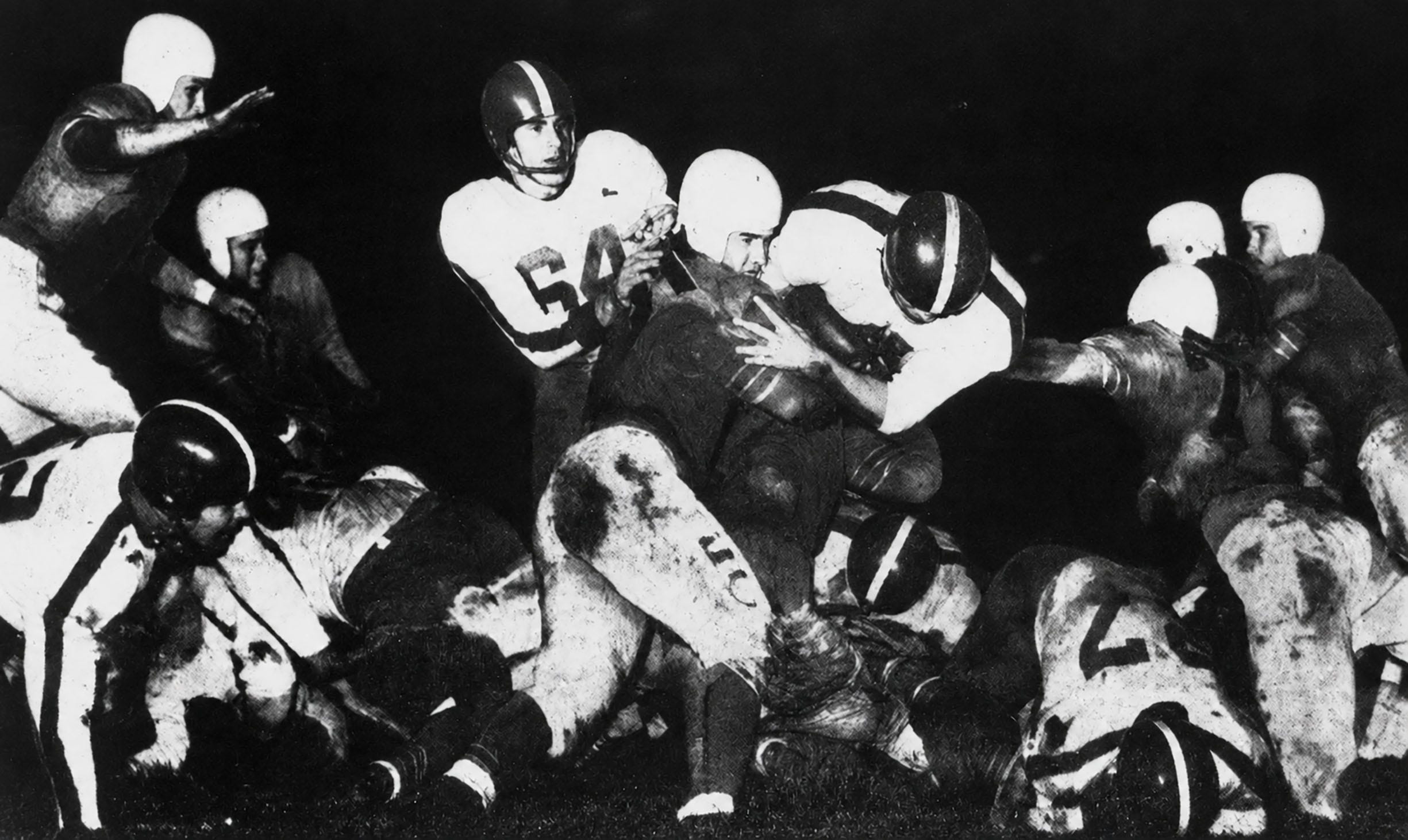
As the AAFC’s inaugural season drew to a close, considerable uncertainty surrounded the future of the Miami Seahawks. The franchise was reportedly about $350,000 in debt, including approximately $80,000 in unpaid payroll and travel expenses. Owner and team president Harvey Hester had stretched his personal finances well beyond their limits in an effort to keep the team operating.
In early December, AAFC commissioner Jim Crowley traveled to Miami to help address the Seahawks’ growing financial problems. While meeting with prospective ownership groups at the McAllister Hotel on Biscayne Boulevard, Crowley also arranged for the league to provide emergency loans to keep the franchise afloat.
Most importantly, the assistance ensured that players would receive their scheduled December 16 paychecks. League funds were also used to satisfy obligations to United Airlines, cover rent at Roddy Burdine Stadium and pay other outstanding expenses as the Seahawks struggled to make it through the end of their first season.
Several groups, both local and from outside Miami, expressed interest in taking control of the struggling Seahawks franchise. One local effort was led by James F.X. O’Brien, president of the Quarterbacks Club and owner of the Tycoon Tackle Company. O’Brien organized a group of investors determined to keep the team in Miami and even explored whether the Seahawks could improve attendance by playing home games on Sunday afternoons, something that was discouraged in Miami in 1946. He approached Mayor Perrine Palmer Jr. and two city commissioners about the possibility, and all indicated that they had “no personal objection” to Sunday football.
A second local group was led by Frank Harney, a prominent sportsman and owner of Manning’s Restaurant at 801 Biscayne Boulevard. Harney assured AAFC commissioner Jim Crowley that “his group could put up the money on 24 hours notice, provided that they didn’t have to assume the present indebtedness of the Seahawks.” His group was prepared to move quickly, but only if it could acquire the franchise without inheriting the financial burden accumulated under the existing ownership.
That condition became the central obstacle for both Miami groups. Neither was willing to assume the Seahawks’ substantial debt, making the financial obligations of the franchise a potential deal breaker. At the same time, interest from outside Miami was growing, with several prospective ownership groups willing to take control of the team if they could relocate the franchise to another city. The Seahawks had therefore reached a critical point: the question was no longer simply who would own the team, but whether professional football would remain in Miami at all.
Bankruptcy and AAFC Takes Over Team
Among those who met with Commissioner Jim Crowley during his stay in Miami was Dr. Mal Stevens, the former head coach of the Brooklyn Dodgers. Stevens discussed the possibility of transferring the struggling franchise to out-of-town investors and was believed to be representing prospective ownership groups from both Philadelphia and Baltimore.
Before either the local or outside groups could present an acceptable offer, however, Harvey Hester filed for bankruptcy on behalf of the Seahawks. Crowley quickly stepped in and assumed control of the franchise for the AAFC, effectively ending Hester’s ownership of the team.
Behind the scenes, Crowley and other league officials were increasingly opposed to keeping the franchise in Miami. Although the city was growing rapidly in the years immediately following World War II, Miami was still only the 42nd-largest city in the United States in 1946. Attendance had also declined sharply as the season progressed.
The team’s poor performance and heavily back-loaded home schedule certainly contributed to the problem, but the Seahawks averaged fewer than 10,000 spectators during their final six home games, a level the league considered unsustainable. With the Miami franchise now under league control, Crowley believed there were other markets that offered a better opportunity for the Seahawks to survive.
Seahawks Franchise to Baltimore
Ultimately, the AAFC awarded control of the former Miami franchise to Washington, D.C., attorney Robert D. Rodenburg and four other businessmen. After securing a stadium agreement in Baltimore, the new ownership group relocated the team and reorganized it as the Baltimore Colts, bringing an end to the Miami Seahawks after just one season in South Florida.
The original Baltimore Colts began play in the AAFC in 1947 and were among the teams absorbed into the NFL in 1950. Their stay in the NFL was brief, however, as continuing financial difficulties forced the franchise to fold after the 1950 season.
Three years later, a new Baltimore Colts franchise was established in the NFL and adopted the name and identity of the earlier team. That second incarnation of the Colts remained in Baltimore until 1984, when the franchise relocated to Indianapolis and became the Indianapolis Colts.
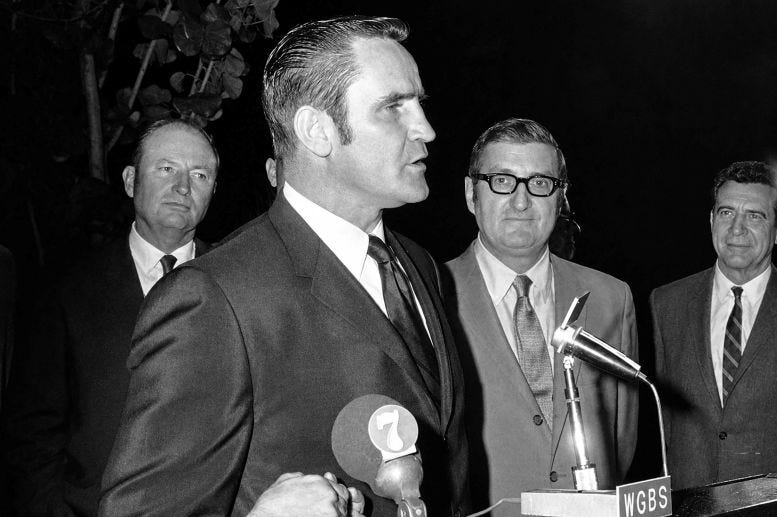
The Miami-to-Baltimore story would take an interesting turn more than two decades later. In 1970, the Miami Dolphins made perhaps the most important acquisition in franchise history when they hired Don Shula away from the Baltimore Colts.
Miami had lost its first professional football team to Baltimore in 1947, but 23 years later Baltimore lost to Miami the man who would become the winningest head coach in NFL history. Under Shula, the Dolphins would soon emerge as one of professional football’s dominant teams, giving the Miami-Baltimore connection a fitting historical twist.
Twenty Years Later
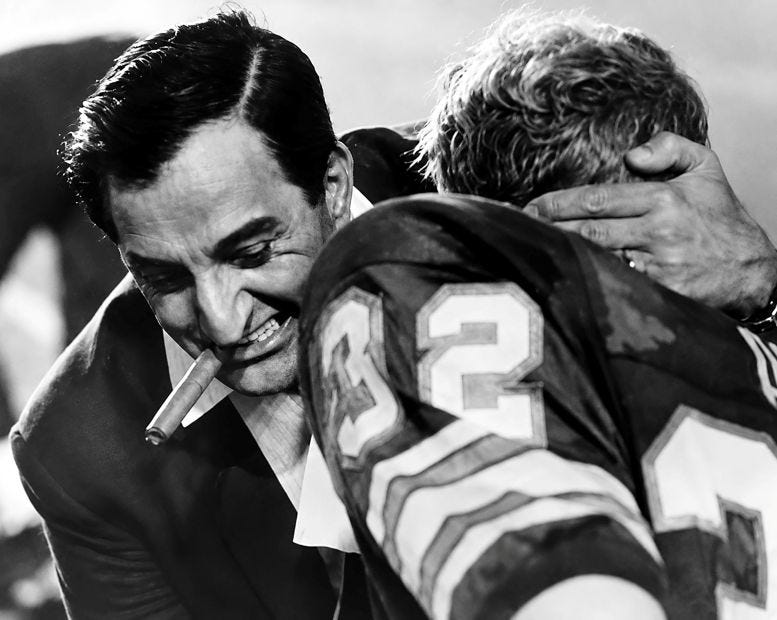
Twenty years after Miami lost the Seahawks to Baltimore, professional football returned to South Florida when Joe Robbie, Danny Thomas, and the Miami community were awarded an American Football League franchise, the Miami Dolphins, in 1966. For fans who have followed the team from the beginning, the Dolphins became source of civic pride throughout South Florida, particularly during the franchise’s remarkable championship run in the early 1970s.
Like Harvey Hester’s Seahawks two decades earlier, the Dolphins encountered serious financial challenges during their early years, and by 1969 the possibility of relocation had become very real. Joe Robbie, however, was able to navigate those difficulties and persuade local business leaders to invest in both the team and his vision for its future.
Robbie’s fiscal discipline also meant that the Dolphins were not overwhelmed by debt, making it possible for new investors to buy out his partner, Bud Keland, who favored moving the franchise. In an ironic twist, the proposed destination was Seattle. Seven years later, in 1976, the NFL awarded Seattle an expansion franchise that adopted a very familiar name: the Seahawks.
The Dolphins have not won a Super Bowl since the 1974 season and have not appeared in one since the 1984 season, but each new year brings hope that the franchise can eventually return to championship contention. As Dolphins fans settle in for another NFL season, it is worth remembering how differently Miami’s professional football history might have unfolded. Had the events of 1946 taken another course, South Florida fans might be chanting “Let’s Go Hawks” today instead. The challenging 1946 season for the Miami Seahawks lasted only one year, but its brief legacy remains an intriguing chapter in the history of professional football in Miami.
Resources:
Book: “From Sandlots to the Super Bowl – The National Football League, 1920 – 1967”, Craig R. Coenen
Miami News: “Miami Gets Franchise in New Pro Loop”, December 10th, 1944
Miami News: “Hester’s Pockets Bulge with Juicy Contracts”, December 13th, 1945
Miami News: “Officials Depart – Miami Grid Pros About Ready”, July 14th, 1946
Miami News: “Jack Meagher Resigns As Seahawks Coach”, October 22nd, 1946
Miami News: “Hester Plans More Changes In Hawks”, October 23rd, 1946
Miami News: “Sale or Shakeup in Seahawks Soon”, December 8th, 1946
Miami News: “O’Brien and Crowley Confer Over Hawks”, December 12th, 1946
Miami News: “Many Dicker for Seahawks”, December 13th, 1946
Thank you, Casey, for yet another extremely interesting, well-researched and very informative overview of professional football in Miami! As a diehard Dolphins fan, I was very much surprised by the football history that preceeded them. My son-in-law is a big Baltimore Ravens fan, and former Colts fan, and I am forwarding the article to him. I'm sure that he will find some of Casey's revelations to be extremely surprising, as well!
Doug deWolfe
Odessa, Florida