


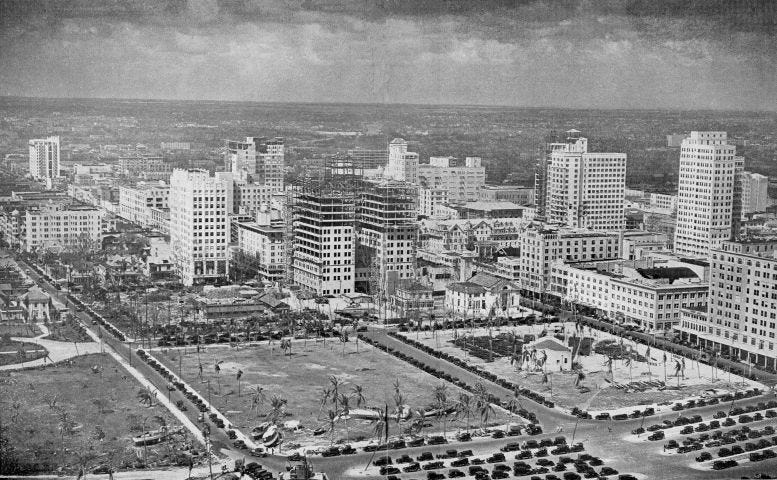
The cover photograph captures a sweeping aerial view of downtown Miami just two weeks after the devastating hurricane of September 17–18, 1926. Taken by Richard B. Hoit from an airplane, the image documents the widespread destruction left in the storm’s wake, a catastrophe that effectively brought an end to South Florida’s real estate boom of the 1920s.
The storm’s impact across the region was profound, and this photograph offers a panoramic view of the damage inflicted on Miami’s central business district. Though not fully visible in the frame, the Royal Palm Hotel, Miami’s first grand resort, developed by the Flagler organization, suffered irreparable damage during the Category 4 hurricane. Its circular entrance can be seen on the left side of the image. The once iconic hotel never reopened after the storm and was ultimately dismantled and demolished beginning in 1928.
In the foreground, the open expanses that were once Royal Palm Park tell another dramatic story of the storm’s force. These grounds became an unlikely resting place for schooners and pleasure boats that had been anchored in Biscayne Bay, some carried more than 1,000 feet inland. The park’s palm trees were heavily battered, with many either damaged beyond recovery or completely destroyed, underscoring the sheer intensity of the hurricane.
At the center of the photograph stands the partially completed Ingraham Building, its upper steel framework still exposed when the hurricane struck. The unfinished top floors endured sustained winds of 128 miles per hour, with gusts reaching as high as 150. Although the structure sustained damage, construction resumed soon after the storm, and the building officially opened on May 1, 1927, as the headquarters for the Model Land Company.
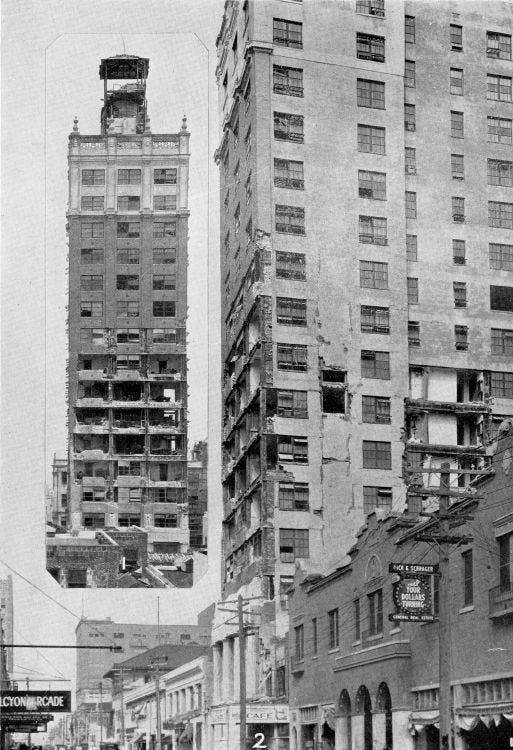
The most severe structural damage in downtown Miami occurred in the building visible to the right, or north of the Ingraham Building, identified as the Meyer-Keyser Building at 139 NE First Street. This 18-story structure, which had opened on March 3, 1926, was twisted during the storm, bending between the fourth and ninth floors. Many feared it would need to be condemned and demolished. Instead, engineers chose to salvage the building, ultimately reducing its height to seven stories as part of a major reconstruction effort rather than tearing it down completely.
The storm’s destruction was driven first by relentless, sustained winds, but it was the surge of water that proved most devastating. As the hurricane pushed a powerful storm surge into the city, downtown buildings were battered, windows were blown out, and floodwaters poured inside, leaving significant damage to lower floors and interior spaces.
While the storm effectively ended any momentum left of the building boom, it did not discourage local leaders from believing the city will build back quickly. When Miami City Mayor Edward C. Romfh spoke, he spoke confidently in not only Miami’s long term outlook, but even the prospects of having a successful upcoming tourist season during the winter of 1926 – 27.
The mayor released a statement, six days after the storm, reassuring those planning on traveling to Miami in the months that followed the great storm:
“I want to give positive assurance that our friends will find Miami this winter the same enjoyable, hospitable, comfortable vacation city it has always been. I predict that Miami will make a world record comeback. The people here have the enthusiasm, the will to do, an unshaken faith in the future of this great city. It is the same people who have created the fastest growing city in America who are now turning their energies and enthusiasm to the work of reconstruction in Miami.”
While those who remained to rebuild Miami were optimistic and persistent, the storm ushered in an economic malaise three years prior to the stock market crash of 1929. While Miami experienced the lows of the Great Depression several years earlier than the rest of the country, by the mid-1930s, through creative promotion and a looming war in Europe, the city began its ascent out of the depression.
A century later, the 1926 hurricane is still regarded as one of South Florida’s most devastating natural disasters. Cutting a path roughly sixty miles along Florida’s coastline, the storm claimed 220 lives, injured more than 6,300 people, and caused an estimated $30 to $100 million in damage, equivalent to roughly $560 million to $1.8 billion today.
Some historians have surmised the catastrophic Miami hurricane actually ushered in the later and wider economic crash of 1929. This being so as so many northern wealthy investors had heavily leveraged themselves in very speculative land purchases in south Florida, losing their fortunes in the ensuing hurricane event of 1926.
On a Personal Note... I’m a native Floridian, born 1950, St. Francis Hospital, Miami Beach. As a youngster of five, in 1955, my then recently emigrated Sicilian grandmother related to me how she... new to Miami, experienced the storm of 1926. In her best English she described the storm as “bad one.” To this day I recall the expression on her face, even then understanding “bad one” was an understatement.
Thank you, Casey. Very interesting and highly informative article! You give a unique perspective on how the 1926 Hurricane affected the downtown business community. It goes beyond the Bay shoreline dramatics to demonstrate that this powerful storm could devistate even the most unlikely downtown structures.