


When Young F. Gray arrived in Miami in 1896, his specialized skills were immediately put to work. A trained dynamite expert from Texas, Gray had been hired by the Florida East Coast Railway to help clear obstacles as the railroad pushed south into the remote frontier of South Florida. After labor crews struggled to cut through dense scrub palmetto and tenacious coastal thicket within the new city limits, pioneer builder John Sewell relied on Gray and other blasting specialists to dynamite the most stubborn terrain and prepare the land for Miami’s early development.
Although the 26-year-old Gray had no previous law enforcement experience, that did not prevent him from seeking public office during Miami’s incorporation proceedings on July 28, 1896. Running against S.S. Puckett for the position of city marshal, Gray won decisively by a vote of 247 to 97. His victory secured his place in history as the first lawman of the newly incorporated City of Miami.
The Early Years
In addition to the city clerk, the marshal was only one of two municipal employees to receive a salary during Miami’s earliest days. Because the position carried such broad authority, including serving as the city’s tax collector, Young F. Gray earned $50 per month along with a percentage of the taxes he collected on behalf of the city.
Gray’s responsibilities extended far beyond preserving law and order. In addition to policing the fledgling community and collecting taxes, the marshal also acted as building inspector, sanitary inspector, street cleaner, and superintendent of sidewalks and roads. For the first two years as lawman, Gray essentially operated as a one-man municipal department tasked with overseeing many of the basic functions necessary to keep the young City of Miami operating.
The ordinance establishing the powers of the marshal also placed important limits and oversight on the position. The mayor held the authority to suspend the marshal for incompetence or malfeasance, while the city council’s Committee on Police and Charities was empowered to supervise many of his day-to-day duties. Even in its infancy, Miami’s municipal government sought to create checks and balances over its first law enforcement officer.
By October 1896, the city council had adopted thirty-five ordinances carrying fines or jail sentences for violators. Some of the regulations reflected the practical concerns, and occasional peculiarities, of life in the frontier town. Among the prohibited acts were “bathing in any public place in a state of nudity” and operating vehicles on Miami’s streets without “a bell, gong or whistle” to warn pedestrians and other drivers at crossings.
More serious offenses requiring detention posed a challenge during Miami’s first year because the fledgling city did not have a jail until December 1896. That winter, municipal officials added a jail above the city council chamber in a makeshift municipal building. The city would not construct its first city hall or police station until 1910. Prior to its completion, writers for the Metropolis would frequently complain that Marshal Young F. Gray was unable to properly arrest “nude bathers, sanitary violators, and other lawbreakers” because there was nowhere to confine them. Once the facility opened, Gray added yet another responsibility to his growing list of duties by serving as the city’s first jailer.
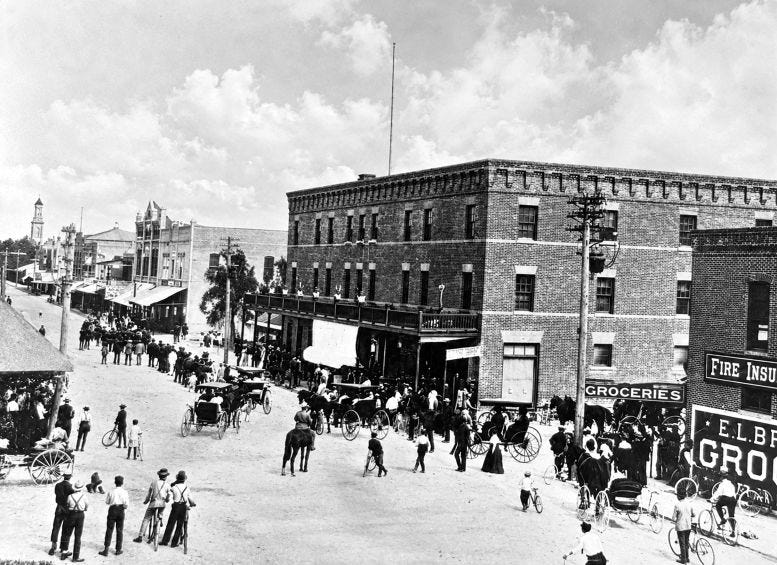
During his first two terms as Miami’s lawman, Gray developed a reputation for enforcing the law with rigor and enthusiasm. He regularly patrolled the young city by bicycle and, according to historian Helen Muir in her book Miami U.S.A., would race toward disturbances “brandishing his pistol” while shouting, “Stop in the name of law!” The image of Gray speeding through the dusty streets on a bicycle reflected both the improvisational nature of policing in early Miami and the larger-than-life character of the city’s first marshal.
