


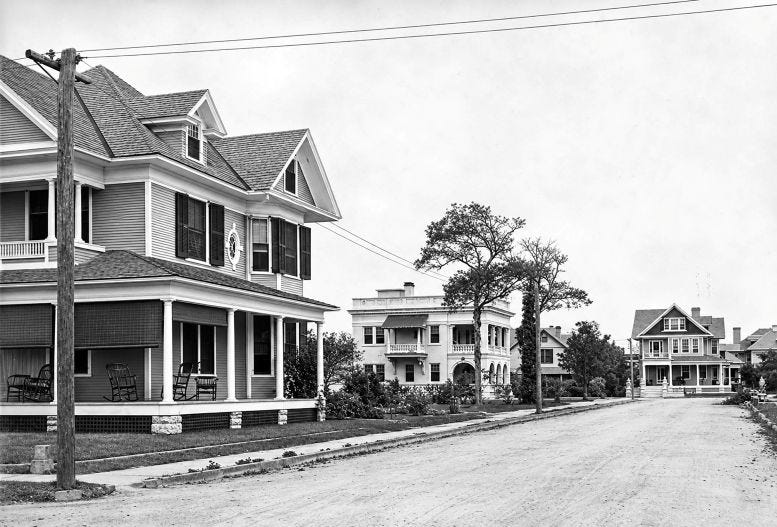
As part of Miami’s incorporation in July 1896, one of the newly established city’s top priority was to develop a plan for laying out and naming the streets within its boundaries. Thoroughfares running east to west were designated as streets and numbered sequentially, beginning at the northern city limits and increasing toward Miami’s original southern boundary. Those running north to south were designated as avenues and assigned letters alphabetically from east to west, beginning one block east of the ‘The Boulevard’ which would later become Biscayne Boulevard.
Most of Miami’s original avenues extended for several blocks, running southward from the city’s northern boundary, near present-day North Eleventh Street, toward and beyond the Miami River. However, Avenue A was a notable exception. Constrained by the natural shoreline of Biscayne Bay, the easternmost avenue extended for only two blocks, making it considerably shorter than the other north-south thoroughfares. This unusual characteristic earned Avenue A the informal nickname “Short Street” among Miami’s early residents, a name that reflected both its limited length and its distinctive place in the city’s original street layout.
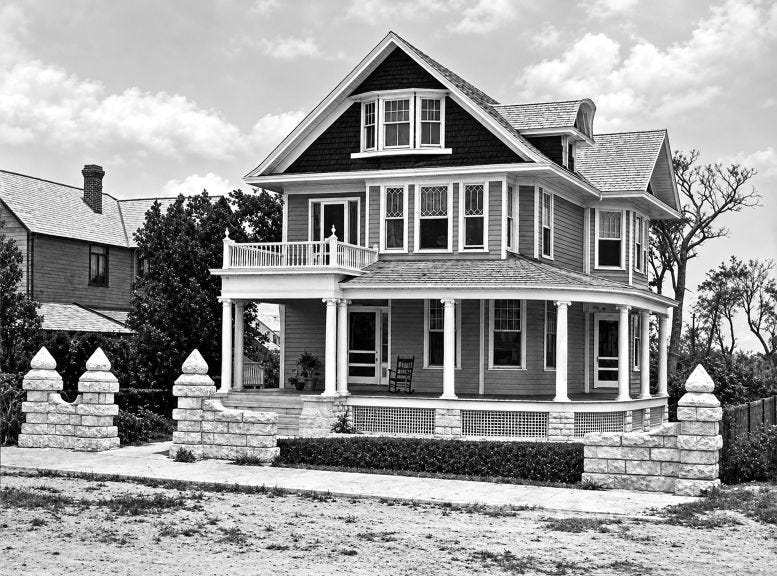
Today, Short Street is officially known as NE Third Avenue, although it retains its original two-block length, extending south from NE Second Street to Flagler Street. When the thoroughfare was first established, its southern terminus bordered the northern edge of Royal Palm Park, which occupied the land immediately south of present-day Flagler Street.
Just west of Short Street’s southern endpoint was Royal Palm Way, a roadway that provided direct access to the grand entrance of Henry Flagler’s Royal Palm Hotel. This picturesque approach to the hotel was later renamed SE Third Avenue and today terminates at Biscayne Boulevard Way.
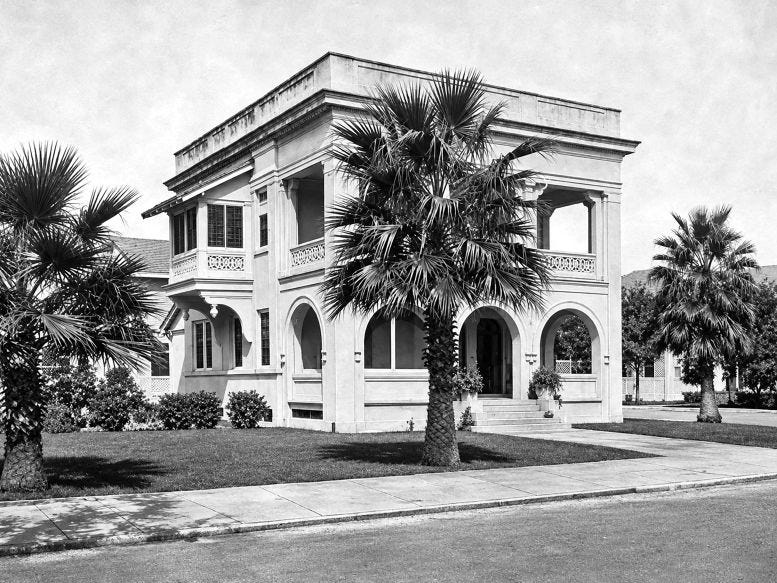
During Miami’s earliest years, Short Street played an important role in welcoming visitors arriving by train. The thoroughfare was part of the preferred horse-drawn carriage route connecting the original Florida East Coast Railway depot, located near the site of today’s Freedom Tower, with the Royal Palm Hotel.
After departing the station, guests typically enjoyed a scenic ride south along The Boulevard (later Biscayne Boulevard), before turning west onto Tenth Street (now NE Second Street). From there, carriages traveled south along Short Street (NE Third Avenue), made a westward turn onto Twelfth Street (now Flagler Street), and continued south along Royal Palm Way (later SE Third Avenue).
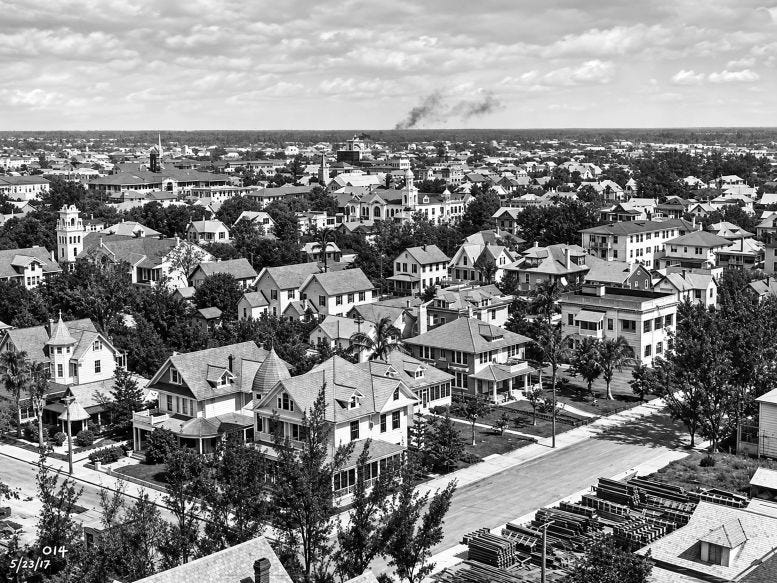
Short Street was one of the first upscale residential areas in Miami. Many of Miami’s early power brokers built their homes along Avenue A to be within walking distance of the bay, as well as to be close to The Royal Palm Hotel and its adjacent park. It was among the most prestigious places to live during the first decade of the Twentieth Century. Short Street and the area around it became the home for notable pioneer merchants, real estate investors, hoteliers, judges and other high-profile early settlers. The beauty and opulence of early Short Street was the reason the procession to the Royal Palm Hotel included a journey down this prominent avenue.
By the mid-1910s, the composition of buildings around and on Short Street began to change. The Elks Lodge was built on the northeast corner of Avenue A (NE Third Avenue, aka Short Street), and Twelfth Street (Flagler Street), in 1912. The YMCA was built along Short Street in 1917, and later, the Fairfax Court Apartments were erected to its south.
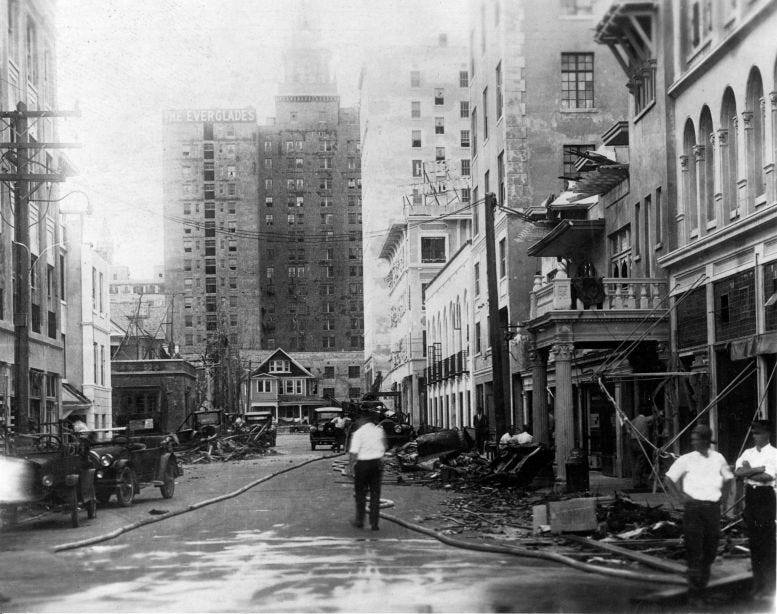
Once the McAllister Hotel opened in 1919, the area was well under way to shifting from a primarily residential neighborhood to what would become a hotel and commercial district. The building boom of the 1920s cemented the very quick transition of the area to become the centerpiece of Miami’s first skyline. One of the hotels that added to the skyline was the Leamington Hotel along Short Street, which opened in the early 1920s and still stands today.
By the middle of the twentieth century, Short Street had undergone a significant transformation, reflecting the changing character of downtown Miami. In the early 1950s, the former site of the Burdine family residence became home to the Greyhound Bus Station, marking another chapter in the avenue’s longstanding connection to transportation and the movement of visitors through the city.
As downtown Miami continues its urban renaissance, NE Third Avenue remains a small but enduring part of the city’s evolving landscape. Although its colorful past may be largely forgotten by those who live and work downtown today, the two-block thoroughfare once known as “Short Street” holds a distinctive place in Miami’s history.
Resources:
Miami Daily Metropolis: “Miami Building Boom Told in Descriptive Paragraphs”, September 23, 1904.
Miami Daily Metropolis: “Ralstons Lease Tatum Corner, Fine Hotel to Built”, February 24, 1917.
Miami Daily Metropolis: “Million Dollar Hotel Be Built by the Ralstons at A and 12th to be Finest in the Southland”, March 6, 1917.
Miami Daily Metropolis: “To Dedicate ‘Y’ Building, One of the Finest in South, with Service this Evening”, May 16, 1918.
Miami Daily Metropolis: “Frissell House to Give Way to Business Block”, May 27, 1918.
Interesting to compare the photo from the hotel to the post-hurricane photo. You can see how much the character of the street had already changed by 1926.