


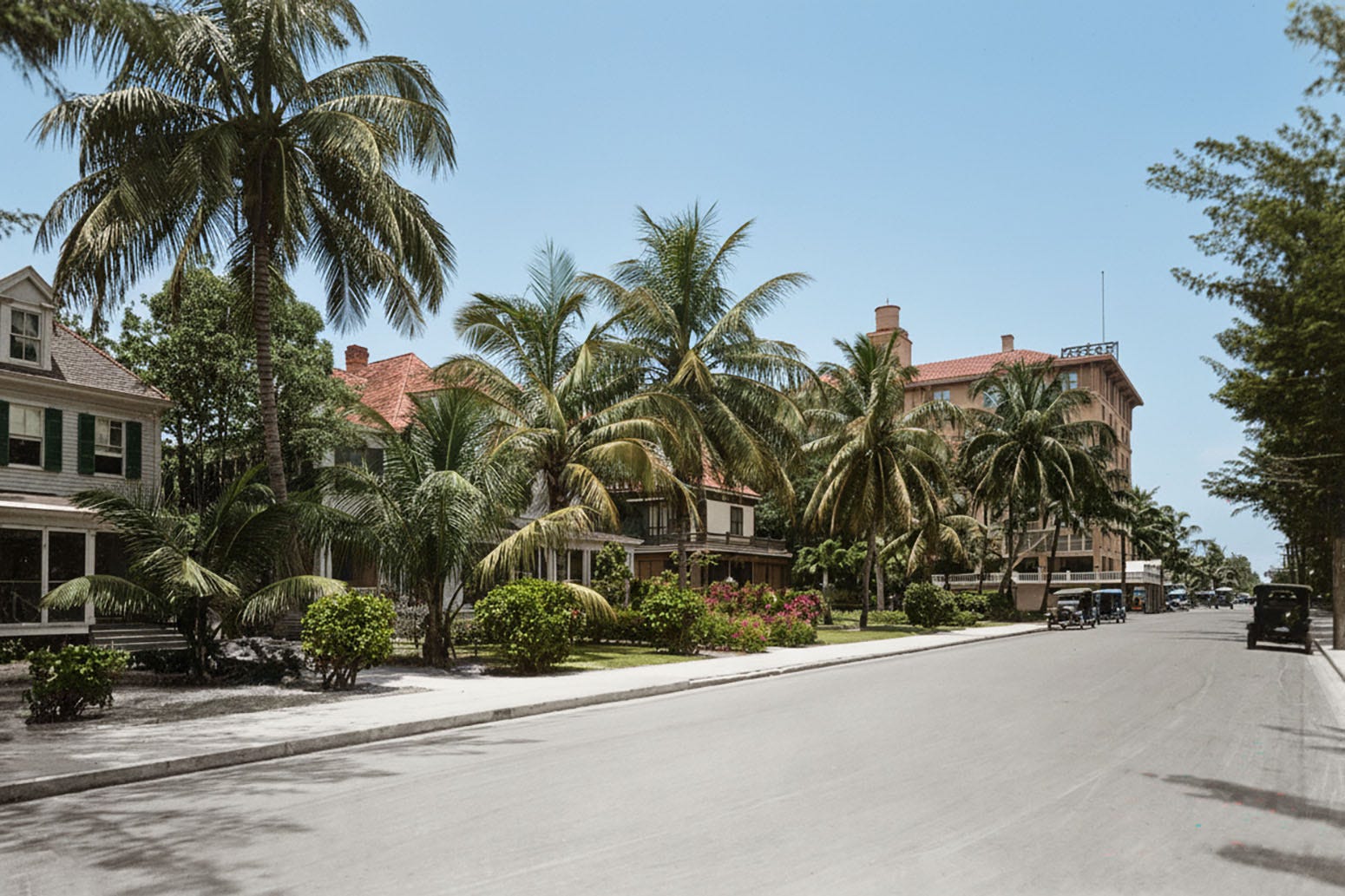
This view captures the final cluster of residences along Southeast Second Avenue at the dawn of Miami’s 1920s building boom. The photograph was taken near SE Second Street, looking north along the avenue, documenting a historic downtown corridor on the verge of dramatic change. During this transformative decade, what had long been a quiet residential quarter would be extensively redeveloped during the pivotal decade of the 1920s.
Known originally as Avenue B, this section of SE Second Avenue began as a residential enclave, home to many of Miami’s early founders and civic leaders. As the city matured, the neighborhood steadily evolved into a commercial and hotel district, with Royal Palm Cottages and Victorian-style single-family homes giving way to larger, more modern structures.
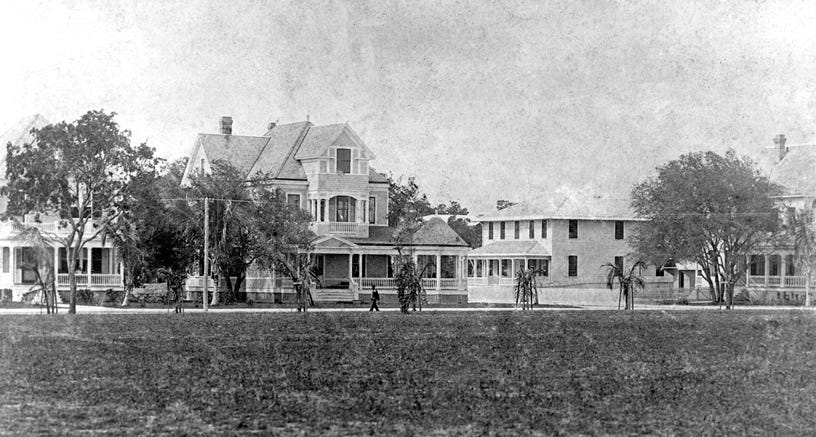
The residence partially visible on the left at 1316 Avenue B, distinguished by its green shutters, was the longtime home of Miami’s first mayor, John B. Reilly. Reilly lived here from 1897 until 1927, when he and his family relocated to the Shenandoah neighborhood.
The house immediately to the north, seen on the right side of the photograph, belonged to Reilly’s father-in-law, Joseph A. McDonald. Entrusted by Henry Flagler with overseeing the construction of Miami, McDonald resided at 1308 Avenue B under the original address system until his death on November 5, 1918.
The structure at 1300 Avenue B under the original address system, located at the corner of SE First Street and SE Second Avenue, just north of the McDonald residence, was among the earliest homes built in the Royal Palm Cottage subdivision. It was constructed by John W. Johnson, president of J.W. Johnson & Company of Key West, Florida.
Over time, the building underwent several transformations, first being converted into the March Villa rooming house and later returned to a single-family residence by Frederic Rand. Rand would go on to become a prominent developer during Miami’s 1920s building boom. In the mid-1920s, he demolished the residence to make way for the Huntington Building, which still occupies the southwest corner of SE Second Avenue and SE First Street today.
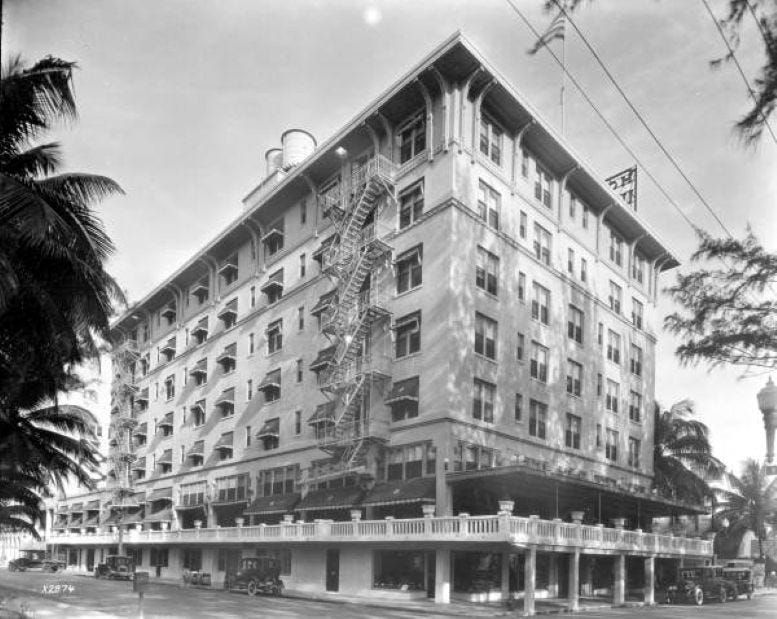
The tall structure visible to the north, across the street from the Rand residence, was the Hotel Urmey, constructed in 1917 by William Urmey. The hotel rose on the former homesite of Lewis Quentin Jones at the northwest corner of SE Second Avenue and SE First Street. In 2005, the Hotel Urmey was demolished and replaced by the Centro Lofts, now occupying the corner at 151 SE First Street.
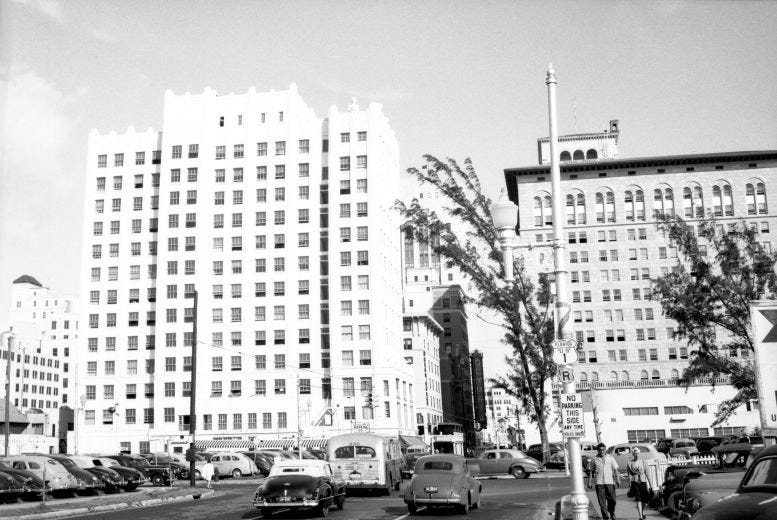
Though this view captures a moment from a bygone era, it reveals the early stages of downtown Miami’s transformation from a patchwork of residential enclaves and modest commercial districts. In the decades that followed, the same streetscape continued to evolve into a landscape of high-rise residential and commercial towers, driven by the city’s growing demand for housing and office space. How downtown Miami will continue to change in the years ahead remains an open and compelling question.