

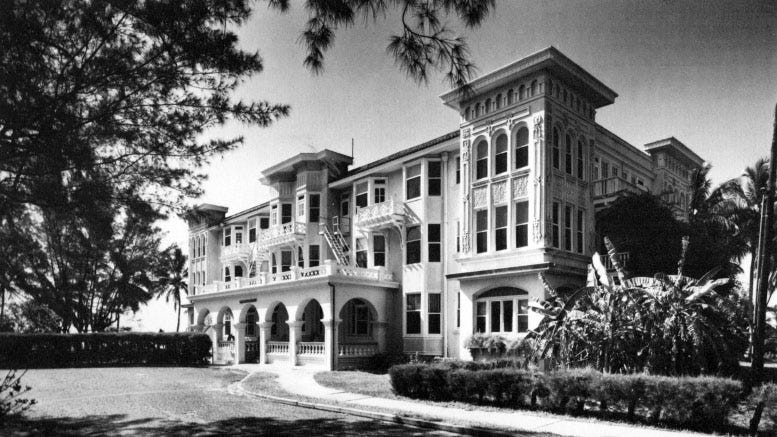
In January 1871, William Brickell departed New York with Ephraim Sturtevant and two hired carpenters, bound for the banks of the Miami River. He brought with him enough lumber and supplies to build two homes, though circumstances ultimately allowed for the construction of only one residence on the river’s south bank.
On December 9, 1871, Mary Brickell arrived with the couple’s six children to join William in the newly completed home. The family included four daughters and two sons. William Jr., the elder boy, was six years old, while Charles was just three.
From their arrival through Miami’s incorporation, the Brickell family steadily expanded their landholdings around their riverfront homestead. By the time William Brickell Sr. died in 1908, both sons had families of their own and were actively involved in managing what had become an extensive real estate enterprise.
During the housing shortage of the 1910s, William and Charles Brickell began developing apartment buildings on portions of their property. This article will focus on the apartment building developed by Charles Brickell aptly named the ‘Brickell Apartments.’
The Brickell Apartments
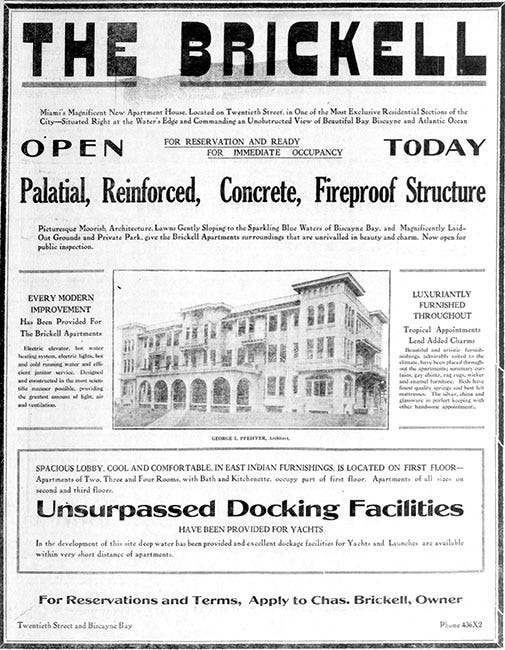
By the mid-1910s, Miami’s rapid growth had created a severe housing shortage, particularly for the seasonal residents drawn to the Magic City during the winter months. This shortage presented an opportunity for local landowners who had extensive real estate holdings such as the Brickell family. Charles Brickell selected a waterfront parcel along the eastern end of Twentieth Street, which was later renamed SE Eighth Street in 1920, to develop an apartment building.
Completed in late 1916 and opened in January 1917, the Brickell Apartments quickly attracted attention. A January 19, 1917, article in the Miami Herald praised the project as “a new structural delight.” The building stood on the south side of Twentieth (later SE Eighth) Street, overlooking Biscayne Bay at a time when Brickell Key was little more than a small spoil island.
The apartments were designed by architect George L. Pfeiffer and constructed by the St. John Construction Company. The site was part of a parcel of land created out of bay bottom fill encompassing approximately eighteen acres. Prior to the creation of this land through dredging, the shoreline in this area had extended to today’s Brickell Bay Drive. With 108 feet of frontage on Biscayne Bay and a depth of 207 feet inland, the building took full advantage of its newly created waterfront setting, offering residents a highly desirable place to live.
The building was described as incorporating elements of Moorish architecture, with a top floor designed to maximize panoramic views in every direction. At the time of its completion, it was said that miles of land and water could be seen from the rooftop.
Visitors entering through the main doorway were welcomed into a spacious reception hall, or rotunda, that blended comfort with refinement. Among the building’s modern conveniences was an electric elevator which was still a rarity in Miami in 1917.
The Brickell Apartments contained twenty-four generously sized units, with floor plans ranging from one to four bedrooms. Each apartment featured a private bath, hot water, electric lighting, and its own balcony, amenities that placed the building well above the standard of the era.
The structure was designed to maximize airflow and natural light, capitalizing on prevailing sea breezes. Constructed of reinforced concrete, it was considered semi-fireproof, a notable contrast to the wood-frame buildings that still dominated much of Miami’s architecture during the city’s early twentieth-century growth.
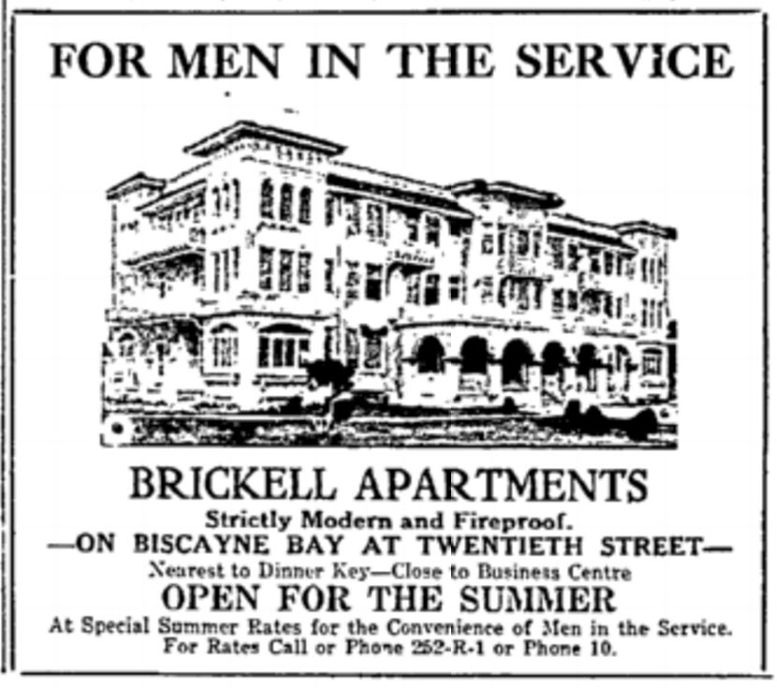
Toward the end of World War I in 1918, Charles Brickell advertised the apartments in the Miami Herald to returning veterans. Many soldiers had trained in Miami before deploying overseas and returned with favorable memories of the city, contributing to a surge in population after the war.
Unlike most Miami apartments and hotels that closed during the summer months, the Brickell Apartments remained open year-round. While downtown institutions primarily catered to winter visitors, Charles and his wife, Fannie, sought to attract permanent residents. In an era before air conditioning, the building’s emphasis on cross-ventilation and cooling sea breezes proved a strong draw for year-round living.
