


When development began on the newly created Star Island in 1919, prospective homeowners were drawn to the promise of an exclusive and tranquil retreat. The private island offered families seclusion, expansive views of Biscayne Bay and Miami Beach, and a sense of separation from the rapidly growing communities surrounding it. For Star Island’s earliest residents, that promise of privacy was largely fulfilled.
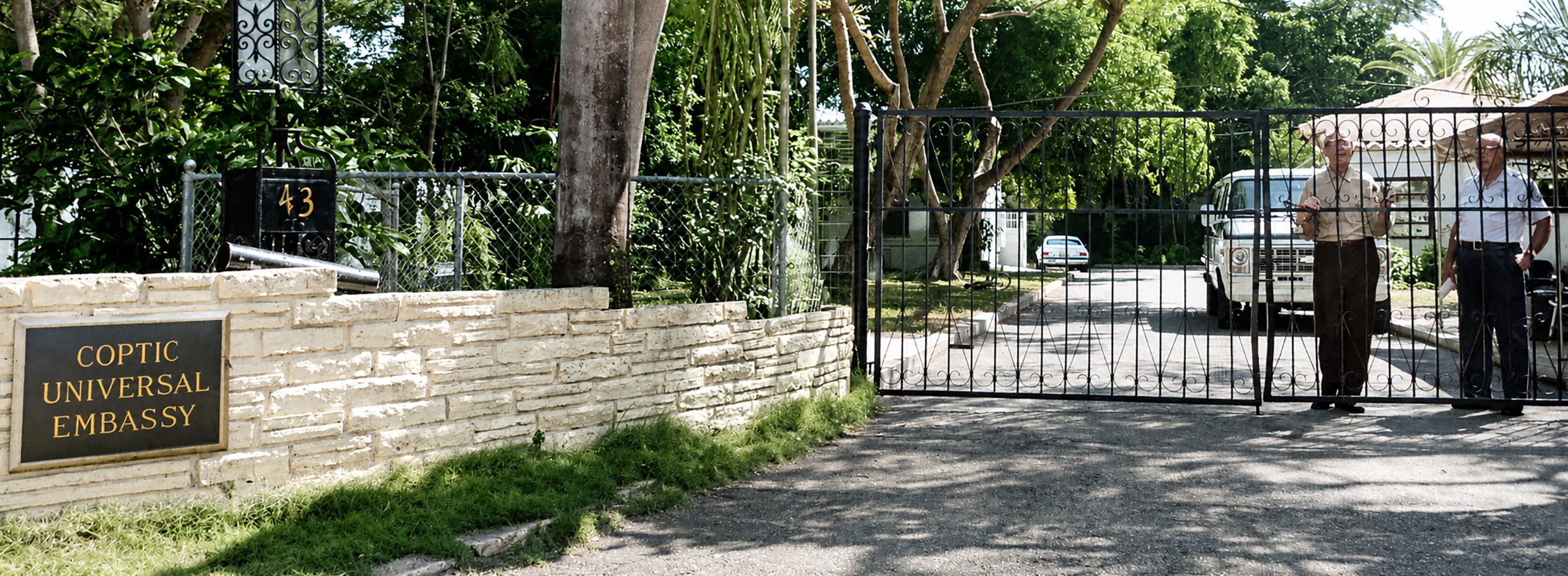
As the island developed, its grand Mediterranean Revival residences, waterfront estates and guarded entrance attracted wealthy homeowners who valued both luxury and security. That atmosphere began to change in the mid-1970s, when members of a religious sect moved into the estate at 43 Star Island Drive. Some neighbors described the group as a cult, while government officials alleged that it was using claims of religious freedom to conceal a large-scale marijuana-smuggling operation.
By 1978, the practices of the Ethiopian Zion Coptic Church, including early-morning chanting and the extensive ceremonial use of marijuana, had ignited an increasingly bitter conflict involving church members, neighboring residents, Miami Beach officials and federal law-enforcement agencies. This is a two-part story of how that confrontation unfolded and how it ultimately came to an end.
Ethiopian Zion Coptic Church
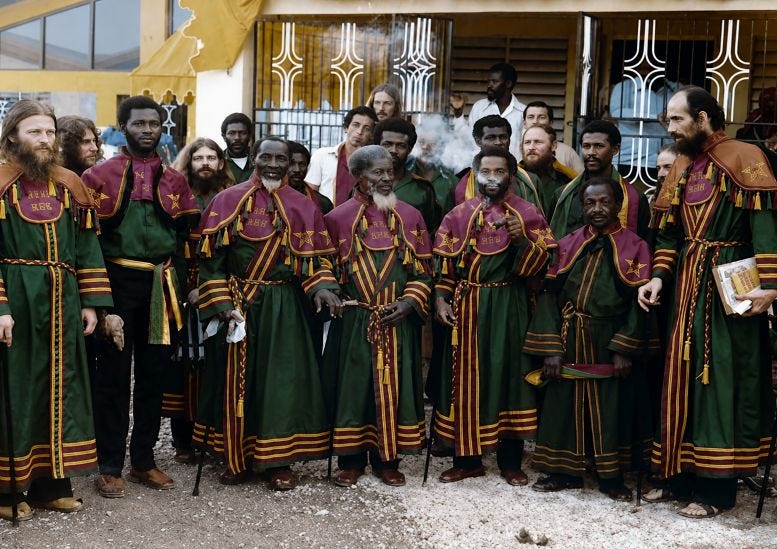
The Ethiopian Zion Coptic Church was a Jamaican religious sect that emerged from the same Black nationalist movement that produced Rastafari, although the Coptic’s regarded themselves as a separate faith. Its origins were associated with Jamaican preacher Lovell “Louv” Williams, who established a religious community in the Mountain View area of Kingston during the 1940s.
After Williams’s death in 1969 and the brief leadership of George “Brother Ivy” Baker, Keith “Niah” Gordon became the church’s principal spiritual leader in 1970. Under Gordon, the movement relocated to rural compounds in Trelawny and later established its principal community, known as Coptic Heights, in St. Thomas. The Jamaican Parliament formally incorporated the church on April 2, 1976.
The church combined a literal reading of the Old and New Testaments with the teachings of Marcus Garvey, Black liberation, economic independence and the belief that people of African descent represented biblical Israel. Its incorporation act described its mission as spreading belief in the Bible, the moral laws of God, the fatherhood of God and the brotherhood of humanity. The Coptic’s taught that salvation required moral living, communal cooperation and a spiritual recognition of God within humanity.
The movement’s defining practice was the use of ganja, the Jamaican term for marijuana, as a sacrament. Members believed that cannabis was a divinely created herb that promoted love, unity, wisdom and spiritual communion with God. Worship included Bible reading, chanting, singing and music influenced by Jamaican traditions such as Kumina. Cannabis use was not limited to an occasional formal ceremony; members commonly smoked throughout the day as part of their communal and religious lives.
During the 1970s, the church attracted a group of mostly white American converts who lived alongside Jamaican members and helped finance the movement’s rapid expansion. The Coptic’s acquired agricultural land, raised livestock, operated trucks and other businesses, and presented their activities as an effort to create an economically independent community that provided work and resources for impoverished Jamaicans. By the end of the 1970s, after several large drug busts, authorities began investigating the Coptic’s Star Island and Jamaican operations as a sophisticated criminal syndicate responsible for smuggling tons of marijuana into the United States.
Thomas Reilly to Brother Louv
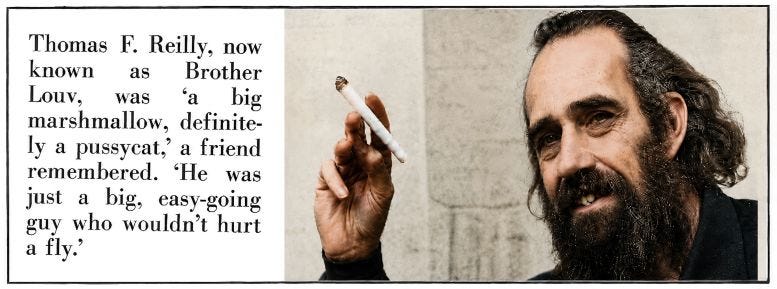
Long before he became Brother Louv, the public face and leader of the Miami chapter of the Ethiopian Zion Coptic Church, Thomas Reilly was a Catholic choirboy from Boston who dreamed of attending the United States Military Academy at West Point. When his dream never materialized, he eventually enrolled at the University of Miami in 1963. Despite his stature, which was 6’7”, he was considered a gentle giant who hated violence and conflict and loved women.
Born Thomas Francis Reilly Jr. on June 10, 1935, in Jamaica Plain, Massachusetts, he was the eldest of five children. His father worked for 28 years as a file clerk for the Eastern Company, a subsidiary of RCA Corporation, before retiring. Reilly grew up in the Boston area and was remembered by his parents as a respectful and obedient son. Exceptionally intelligent, he reportedly had a measured IQ of 141.
Reilly served as a choirboy for five years and played both football and basketball as a young man. Given his height, reporters later asked whether he had considered playing basketball for the University of Miami. He responded simply that basketball star Rick Barry was already on the team when he arrived. During his college years, Reilly lived much like many other students: he drank, attended parties, danced and rarely missed a Hurricanes football game. Friends recalled that he studied and discussed each play with the enthusiasm and attention to detail of a coach.
By the time Reilly arrived in Miami, he had abandoned the Catholic faith of his childhood and considered himself an atheist. He later explained that he had grown dissatisfied with the responses he received from priests when he questioned church teachings. In a December 1978 interview with Miami Herald reporter Joe Oglesby, Reilly recalled, “I would ask questions, and many times they would give answers that said to me, ‘This is a mystery, and you can’t know this.’”
While attending the University of Miami, Reilly supported himself by selling insurance for Jefferson Standard Life and later working for Moore Business Forms in Coral Gables. In 1965, he left the university without earning a degree. He remained in Miami, took a job with a data-processing company and eventually joined two partners in establishing a business of their own.
Within a few years, however, Reilly became disenchanted with corporate life and left the partnership. He said he smoked marijuana for the first time in 1969, after which he traveled to Northern California and spent time in San Francisco’s Haight-Ashbury district. There, he encountered members of the counterculture whose stories and ideas sparked his interest in Jamaica. In January 1970, Reilly boarded a flight to the parish of St. Thomas, Jamaica, a journey he later claimed he made while under the influence of LSD.
When he arrived in Jamaica he was introduced to the Zion Coptic leaders and felt comfortable with the teachings of the Coptic religion. In the aforementioned article, Reilly shared the following:
“A friend introduced me to a congregation of (Coptic) people who answered my questions about the effects of smoking marijuana for periods of up to 40 years. They showed me the Biblical references to herbs, to make burnt offerings. They told me that God made grass for the cattle and herbs for the service of man. They said ganja is not a drug; it is not dangerous; it is a gift for those who freely choose to accept it.”
Reilly spent the next four years living at a Coptic retreat in the parish of St. Thomas, Jamaica. During that time, he fully embraced the teachings and communal practices of the Ethiopian Zion Coptic Church, including its belief that ganja, or marijuana, was a sacred herb and an essential religious sacrament.
When Reilly returned to Florida with several fellow church members, the group initially settled in Fort Myers but remained there only briefly. They soon relocated to Southeast Florida and purchased a house at 6724 Southwest 12th Street in Miami. As the congregation grew and its members sought greater seclusion, they began searching for a more private setting. Their search ultimately led them to Star Island, where they purchased a waterfront mansion that became the headquarters of the church’s Miami community.
Acquisition of Star Island Mansion in 1975
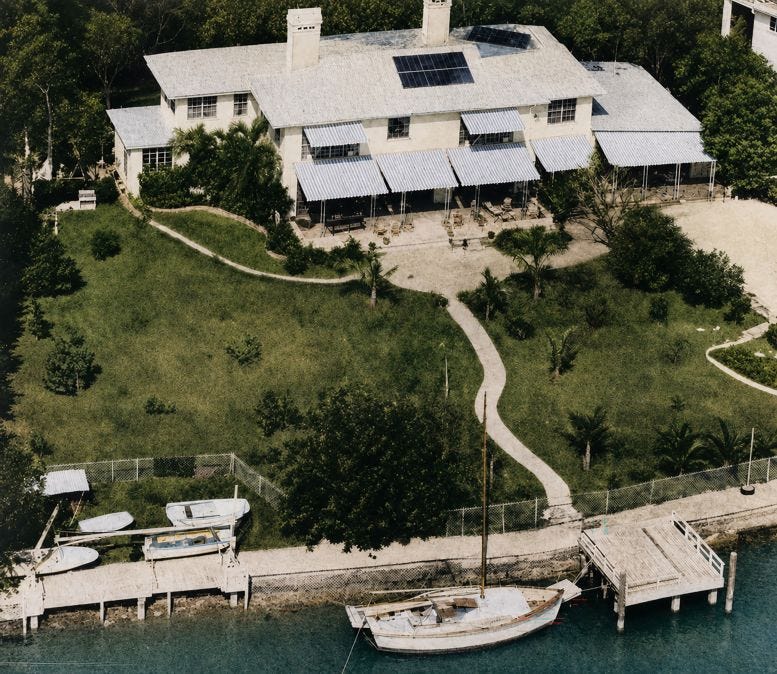
After members of the Ethiopian Zion Coptic Church established themselves in the Miami area, they frequently came under the scrutiny of local law-enforcement agencies. Reilly later characterized this attention as persistent harassment. In a January 1978 interview with the Miami Herald, he recalled, “Practically every place we went—we lived in modest conditions—we were raided.” He added that he did not believe the raids were part of an organized conspiracy, but rather a reaction from local residents and authorities who saw “a bunch of longhairs living together.”
