


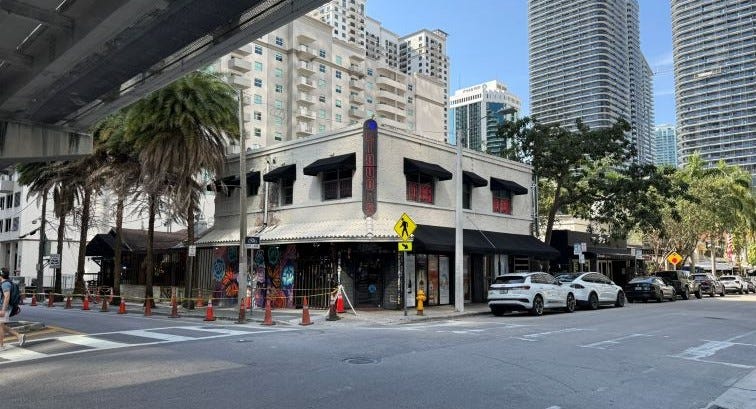
A modest two-story building tucked within the ever-evolving Brickell neighborhood has long sparked curiosity: what was it, and how has it endured as the area transformed into what many now call the “Manhattan of the South”? Constructed when Brickell was still primarily residential, the structure has occupied the corner of SE Tenth Street and South Miami Avenue for more than ninety years, quietly bearing witness to the neighborhood’s dramatic evolution.
Over the course of its lifetime, the building has housed a variety of tenants, though it has consistently served a few core roles within the community. During its first half-century, the structure operated as a neighborhood meat market and grocery store, with the proprietors living above the shop on the second floor, a classic “mom-and-pop” arrangement. In the past thirty years, it transitioned into a series of restaurant concepts before ultimately returning to its retail roots, most recently serving as a liquor store catering to Brickell’s growing population.
The Gillespie Building stands on land once owned by the developers of the Martina Apartments, located directly across the street. After the apartment building fell into bankruptcy in 1924, C. F. Turner of Dixie Development acquired both the apartment complex and the parcel across the street. Several years later, in 1932, a modest two-story building rose on the site, designed with retail space on the ground floor and residential units above. The property was originally addressed as 1044 South Miami Avenue.
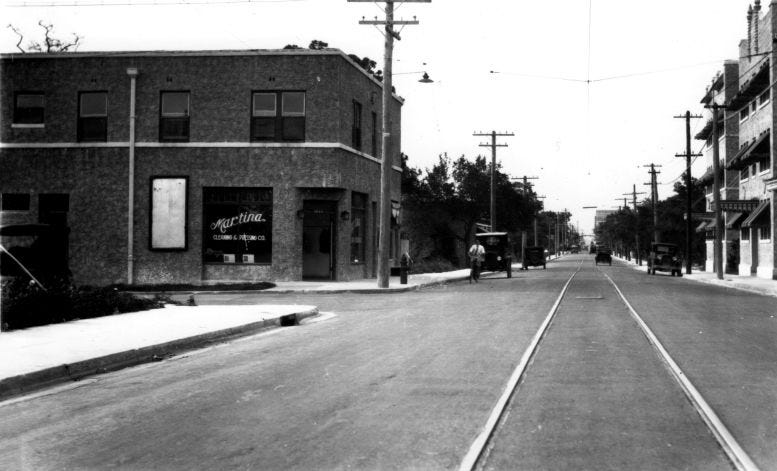
The building’s first tenant was Martina Pressing and Cleaning, though the business lasted only a few years. In 1934, Jack Gillespie opened a neighborhood grocery store at the location, operating it until 1941. Following his tenure, the market continued under a succession of owners and names, including Ungar’s Food Market (1941–1949) and Southside Market (1950 through the early 1980s). After 1982, the historical record grows less clearly, with no mentions in local newspapers until a restaurant occupied the ground floor in 1996. At was at this time the building’s address was also changed from 1044 to 1040 South Miami Avenue.
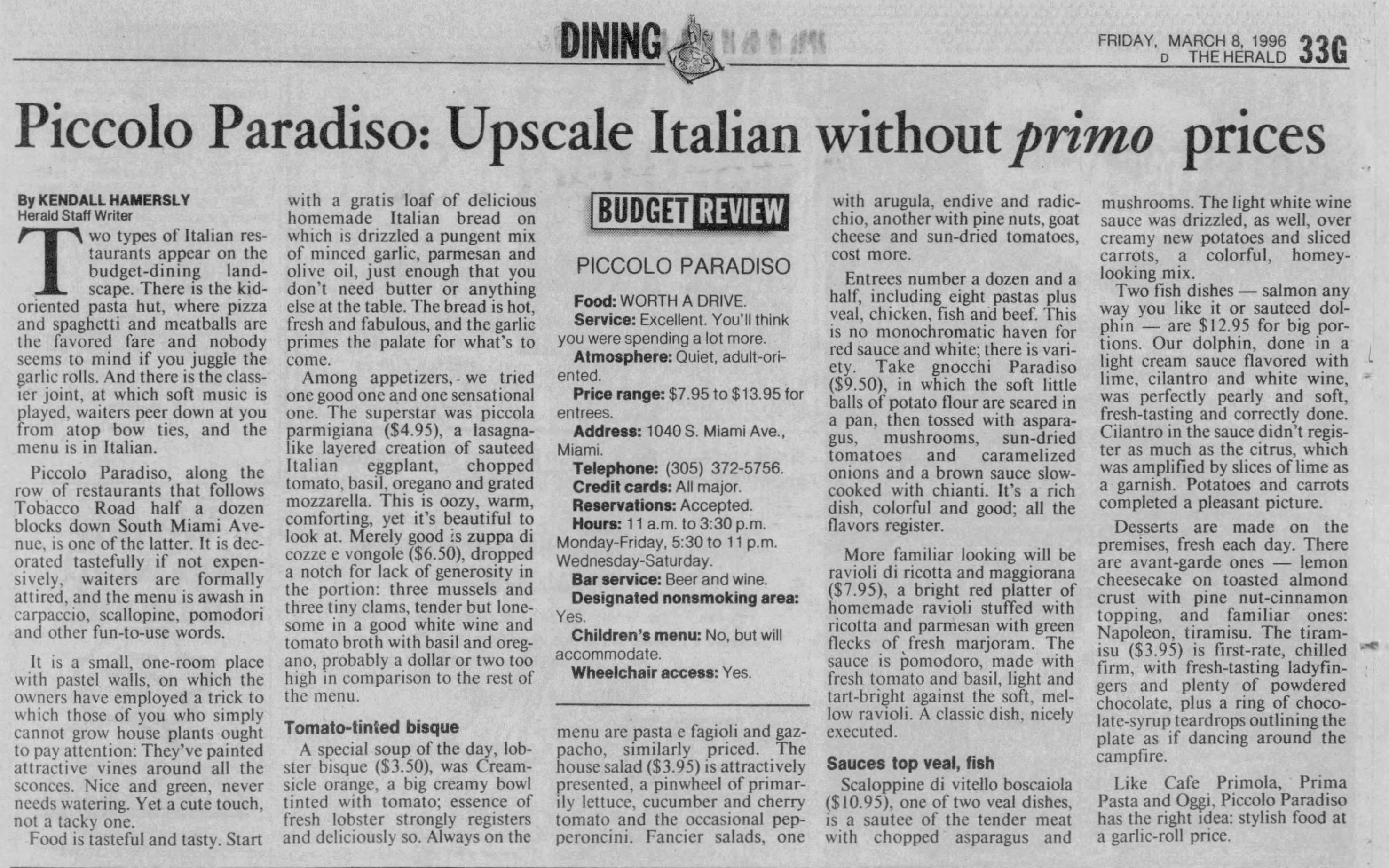
In March 1996, the Gillespie Building welcomed Piccolo Paradiso, an Italian restaurant that opened to strong reviews. Kendall Hamersly, dining critic for the Miami Herald, praised it as “upscale Italian without primo prices.” At a time when Brickell offered few dining options compared to today, the modest establishment provided a welcome addition to the neighborhood’s limited culinary scene. Despite the favorable press, however, Piccolo Paradiso closed after just two years.
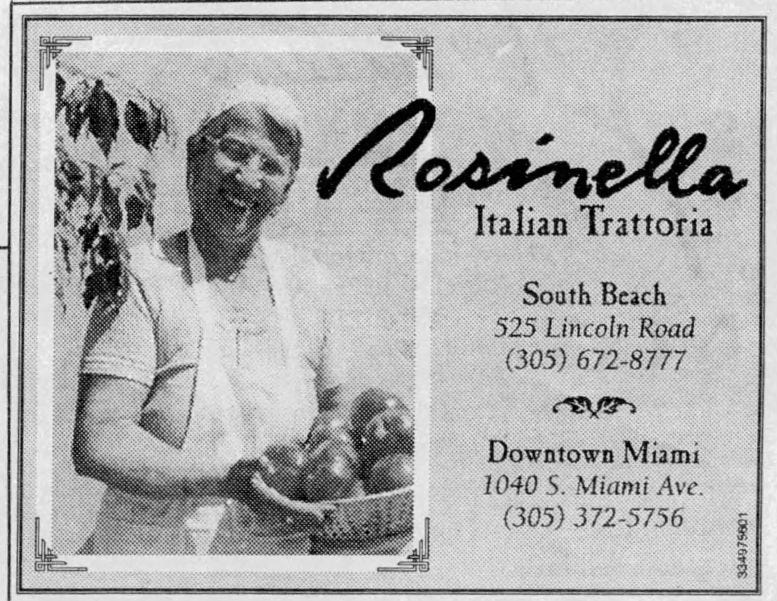
In 1998, the space was taken over by another Italian concept, Rosinella Italian Trattoria. Already established on Lincoln Road in South Beach, the owners expanded into Brickell, recognizing the area’s growing residential base and untapped potential. Over the next fifteen years, Rosinella maintained a steady presence in the building, gradually evolving from a traditional restaurant into more of a market-style operation during its tenure.
In January 2012, the Gillespie Building and the adjacent parcel to its west were sold to FX S MIA LLC (Miami Ave Holding Company) for $5 million, a significant increase from the $800,000 paid by the previous owners in 2000.
After Rosinella vacated the space in 2013, the building entered a period of transition, with several restaurant concepts coming and going with limited success. That same year, Sumi Yakitori opened, offering authentic Japanese cuisine. It was a sister concept to the successful Momi Ramen, which had opened next door earlier and remains in operation today. Despite that connection, Sumi Yakitori closed its doors in 2017.
In 2018, another Italian concept, Empanazzio, took over the space but shuttered by the time the COVID-19 pandemic forced widespread business closures in early 2020. Since 2021, A5 Liquors has operated out of the Gillespie Building. However, the site, at the prominent corner of South Miami Avenue and SW 10th Street, is now slated for redevelopment, with plans calling for an eighty-story mixed-use tower that will dramatically transform this long-standing corner of Brickell.
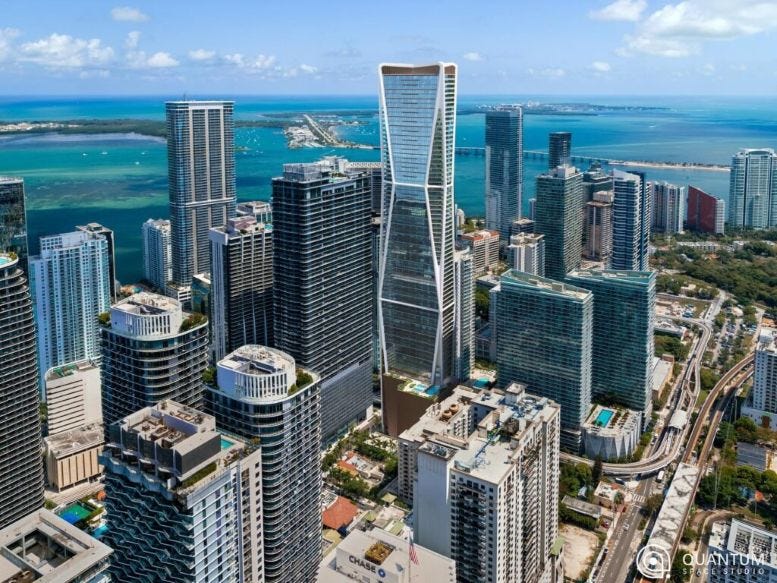
A recent notice announced a preliminary zoning hearing before Miami-Dade County to consider transferring oversight of a proposed development by FX South Miami LLC from the city to the county. The shift is under consideration because the property qualifies for special exceptions under the county’s Metromover Subzone of the Rapid Transit Zone (Section 33C-15). If approved, county oversight would allow the project to bypass certain municipal zoning regulations, including height limits and parking requirements.
The proposed development, currently known as the 1040 South Miami building, would occupy approximately 0.57 acres and rise to 80 stories, reaching about 945 feet. Plans call for a mixed-use tower incorporating residential, hotel, and retail components. The site, previously slated for a Virgin Hotel, lies within a block of a Metromover station, making it eligible for county jurisdiction under the transit-oriented zoning provisions.
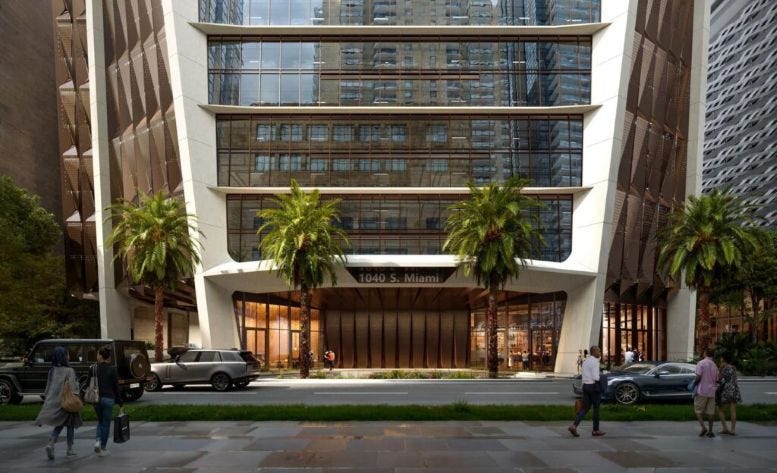
A more detailed description of the proposed building was provided by Oscar Nunez published on the Florida Yimby website on May 6, 2026:
“The development is set to include 250 condominium units, 48 condo-hotel units, 100 hotel rooms, approximately 1,900 square feet of restaurant space, and 322 parking spaces. The total gross floor area is estimated at 1,084,278 square feet. ODP Architecture & Design is listed as the architect for the project. Prosper Group, led by Jay Roberts, and Forte Development, led by Marius Fortelni, are co-developing the project under the entity 1040 S Miami Development LLC.”
Residents of Brickell who regularly rely on the Metromover may reasonably question whether the existing system can accommodate the influx of people an 80-story tower would bring. It is hoped that Miami-Dade County will commit to significant upgrades to the area’s rapid transit infrastructure before projects under its jurisdiction begin adding new residents to the neighborhood.
A charming, quaint, historic building! Soon to be gone.
Our link to the grand days of Miami is right here at Miami History.
Another one bites the dust.