


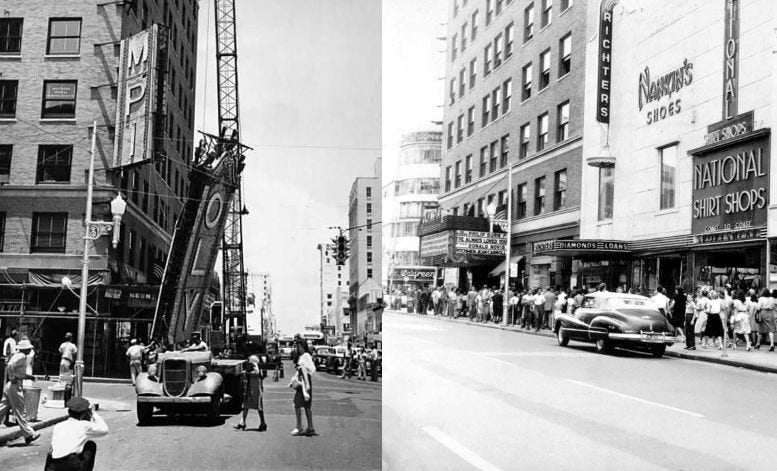
While researching the Olympia Theater in preparation for its centennial, I found myself drawn to a lingering mystery: what became of the massive vertical sign once mounted on the building’s northeast corner? Installed in 1926 as the final major exterior addition before the grand opening on February 18 of that year, the towering marquee was a defining feature of the façade. Yet by the mid-twentieth century, it had quietly vanished.
As architect John Eberson and the general contractor awaited delivery of the custom-built sign to Miami, the theater’s owners, Paramount Enterprises, anxiously hoped it would be secured in place before opening night. Once installed, the vertical electric display ranked among the largest and most striking theater signs in the South, perhaps even in the nation. This is the story of that immense electrical sign, erected in 1926 and ultimately removed two decades later in 1946.
Installation of Overhanging Sign in 1926
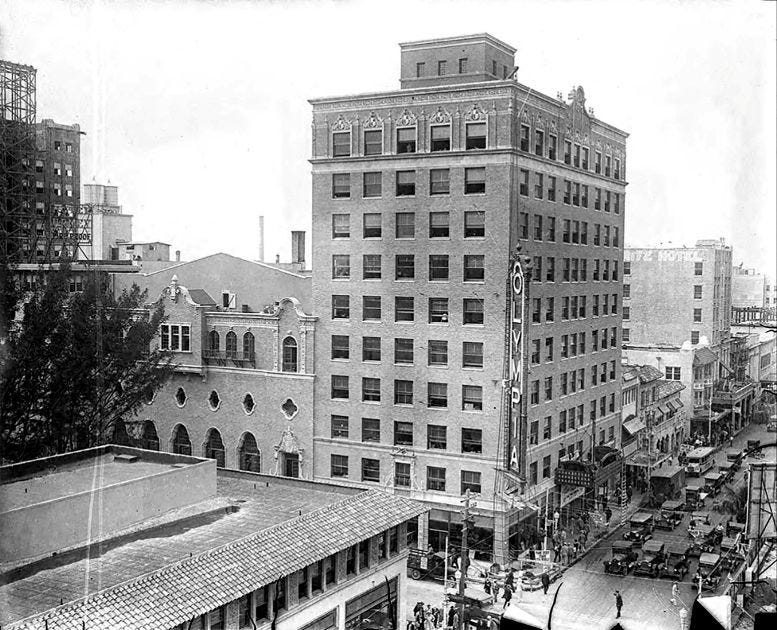
In early February 1926, the long-anticipated components for the exterior sign of the Olympia Theater finally arrived. Because of its extraordinary scale, the contractor charged with its installation had to carefully engineer how it would be secured to the structure. Weighing nearly two tons, the copper sign required anchoring directly into the building’s foundation to support its immense mass. Though monumental in size, it was thoughtfully designed so that its architectural lines complemented the detailing of the theater itself.
For nearly two weeks, curious onlookers lined Flagler Street to watch the installation unfold. When the work was completed on Wednesday, February 11, the city issued the permit for the towering electric display, 55 feet high and 10 feet wide, confirming that the theater’s exterior would be ready for its much-anticipated grand opening.
The sign was said to be the largest theater advertisement in Florida and the largest hanging sign in the South. Composed of 3,500 electric bulbs, it spelled out “Olympia” within a dynamic border of moving lights. Above the “O,” a heraldic crest rendered in colored illumination added a dramatic touch. The brilliant display served as a fittingly grand accessory to a building designed to house one of the region’s most lavish theaters.
Norden Sign Company
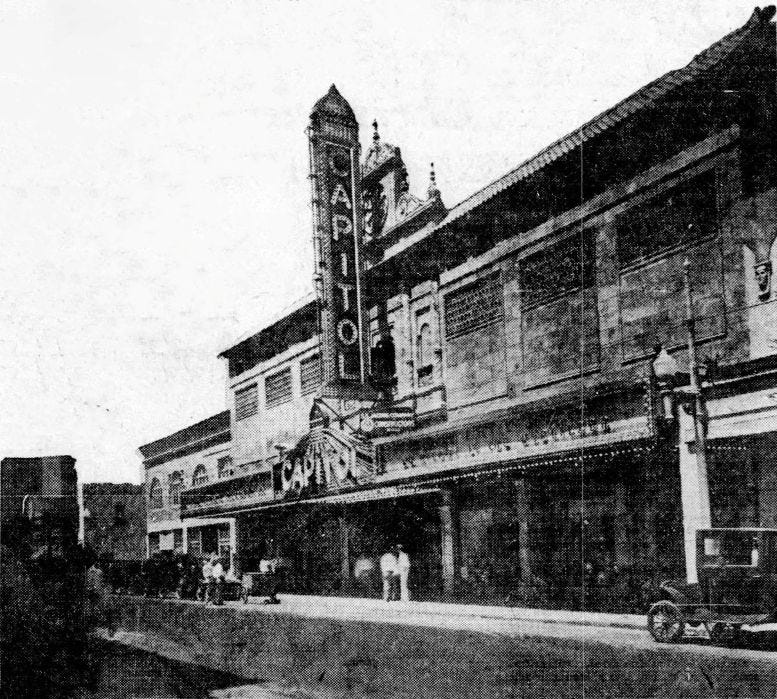
On May 1, 1926, the Miami Herald reported that Mortimer Norden, president of the Norden Sign Company, had arrived in Miami to inspect the massive electric sign his firm had designed and fabricated for the Olympia Theater. The company was well known for its association with Famous Players-Lasky, having produced several electric theater displays for the organization across the country.
Norden’s firm had already earned international recognition for its spectacular illuminated signage. Among its most notable projects was the sprawling “Covered Wagon” display erected in New York, London, and Paris. The company also created the enormous “Ten Commandments” sign on Broadway, measuring 200 feet long and 40 feet high at a cost of $57,000. At the time of the Herald’s report, the firm was constructing a sign for Keith’s Palace Theater that would briefly rank as the largest theater sign in the world during the 1920s.
Norden’s trip to Miami was not limited to reviewing the Olympia installation. He also conducted a site visit for the Capitol Theater on behalf of the Wolfson-Meyer Theater Company. Plans there called for a grand marquis stretching 100 feet across the façade, paired with a vertical sign rising 100 feet into the skyline, another bold statement in an era defined by theatrical spectacle.
On July 30, 1926, John D. Pike, superintendent for the Norden Sign Company, traveled to Miami to address concerns raised by the City of Miami Fire Department regarding the towering sign at the Olympia Theater. A storm earlier that month had caused the vertical structure to sway noticeably, prompting concern from the fire inspector.
After overseeing repairs, Pike assured city officials that the issue had been resolved. He explained that “the top piece has been fastened in place by a large iron band, which holds it rigid, and supporting cables are strung from both sides. The bottom support, of course, was always secure, amply supporting the weight of the sign, as it is a steel girder in the framework of the building.” With these reinforcements in place, Pike expressed confidence that the sign would withstand future storms.
What he could not have anticipated, however, was the generational hurricane that would put those assurances to the test. Just weeks later, in September 1926, one of the most powerful storms in South Florida’s history would bear down on Miami, challenging both the engineering of the sign and the resilience of the city itself.
Damaged During 1926 Hurricane
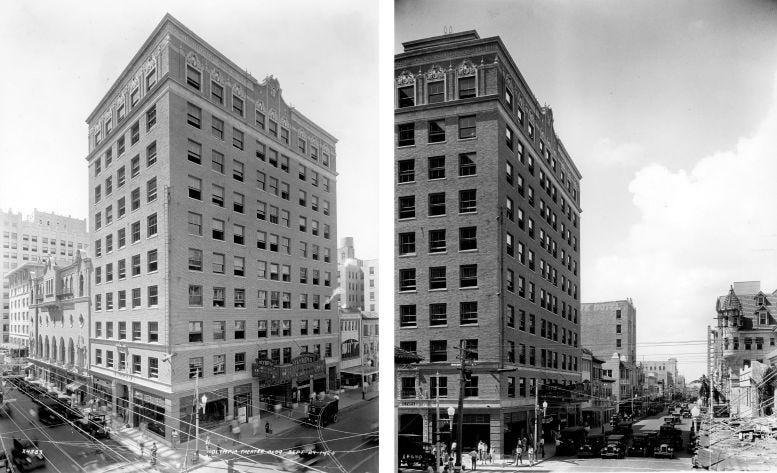
On September 17, 1926, Miami was struck by one of the most devastating hurricanes in United States history, the Great Miami Hurricane of 1926. According to the American Red Cross, 372 people lost their lives and more than 6,000 were injured in the greater Miami area. Officials estimated that over 4,700 homes across South Florida were destroyed, leaving approximately 25,000 residents without shelter in the storm’s aftermath.
The hurricane tore directly through the heart of downtown, inflicting heavy damage on buildings throughout the city’s core. Among the most dramatic losses at the Olympia Theater was the destruction of its 55-foot-tall electric vertical sign. One of the largest and heaviest signs in the city, it was ripped from the façade at the height of the storm and crashed to the pavement in sections. Debris from the massive structure scattered for nearly half a block along East Flagler Street, smashing storefront windows on Miami’s main commercial corridor.
In the immediate aftermath, police officers stood guard outside damaged shops where shattered glass had exposed valuable merchandise to the street. Much of the destruction was compounded not only by the impact of the falling steel and metal, but by wind-driven rain that poured through broken windows, streaming past sills and flooding interiors.
In the aftermath of the storm, theater management once again engaged the Norden Sign Company to construct and install a replica of the original vertical sign. Within a year, the restored beacon would once again rise above the Olympia’s façade, this time 63-foot in height, remaining in place until the Miami City Commission moved to regulate what it increasingly viewed as excessive and intrusive signage across the city.
City Ordinance in 1941
In the fall of 1941, the Miami City Planning Board urged the City Commission to adopt an ordinance regulating building-mounted signage. The board felt that there were too many signs affixed to buildings that were designed to overshadow competing interests, particularly in downtown Miami. Although many of these signs were permanently affixed to their buildings, they projected outward and, in numerous cases, contributed to a cluttered and unattractive streetscape.
The proposed measure, known as the Beautification Ordinance, underwent revisions after theater owners objected to its initial restrictions. In response, the final version allowed limited exceptions for signs rising vertically from a theater’s marquee. The City Commission approved the ordinance on Thursday, December 11, 1941.
The law applied retroactively, requiring any existing sign that violated its provisions to be removed within five years. It specifically prohibited vertical signs that formed part of a supporting structure or projected more than four feet from a building’s façade. Theater signs attached directly to a marquee were permitted, provided no additional signs were suspended from them.
Despite the carve-out for theaters, the vertical sign mounted on the northeast corner of the Olympia Building did not qualify for the exemption. Because it was detached from the theater’s marquee, it fell outside the ordinance’s allowance and became noncompliant upon the law’s enactment. As a result, the Olympia Theater’s management was given until July 11, 1945, to dismantle the prominent vertical sign.
Removal of Sign in 1946
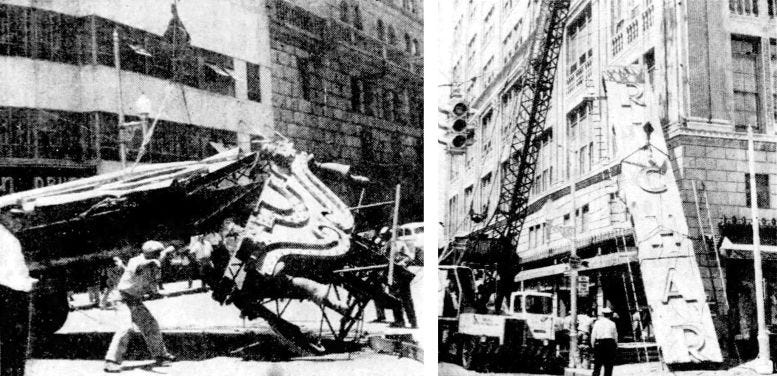
A June 25, 1946, an article in the Miami Herald reported that George N. Hoover, manager of Paramount Enterprises, had signed a contract to dismantle the Olympia’s 63-foot electronic sign, still regarded at the time as the largest in Florida. Hoover acknowledged that the structure had to be removed by the July 11 deadline and announced that Hal Pereira, a New York architect associated with the Paramount organization, would arrive within two weeks to begin planning for its removal.
Hoover also outlined plans for a comprehensive redesign of the Olympia’s front façade, including the installation of a new and even larger built-in sign, likely referring to the marquee above the theater’s entrance. He characterized the proposed alterations as “major,” though he did not disclose an estimated cost.
Under the ordinance, property owners who failed to comply faced fines of up to $500. By mid-June 1946, approximately 90 percent of the nonconforming signs had already been taken down. The two most prominent remaining violations were the large signs atop the Olympia Theater and Richard’s department store.
On Sunday, July 7, 1946, workers temporarily closed a portion of Flagler Street as crews began dismantling the Olympia’s towering electric sign. As the 63-foot structure was lowered to the street by derrick, its upper section snapped loose and broke apart. Within a matter of hours, the 20-year-old landmark that had long defined the corner of East Second Avenue and Flagler Street was gone from the streetscape.
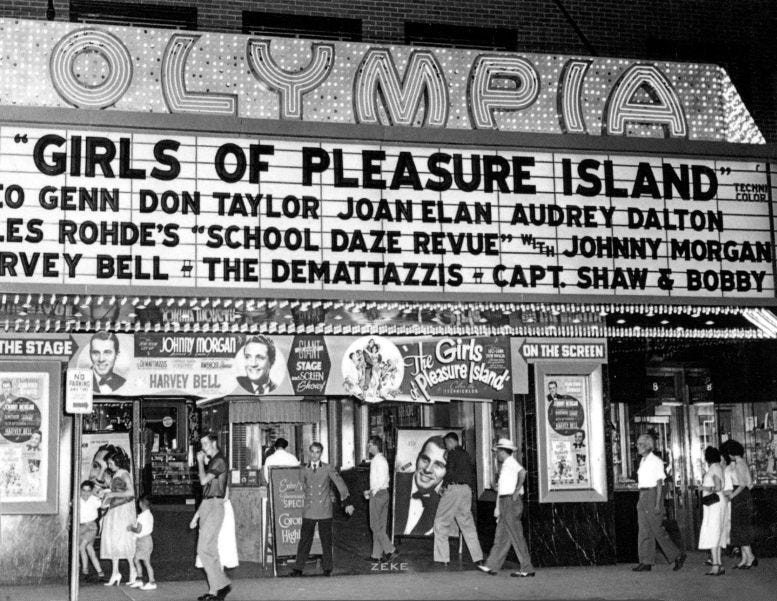
In its place, the Olympia undertook a redesign of the theater’s façade, enlarging the marquee above the main entrance to better promote current and upcoming attractions. Although today’s marquee differs from its mid-twentieth-century predecessor, it continues to illuminate Flagler Street, serving as a reminder to modern-day Miamians of more than a century of entertainment inside one of the city’s most iconic venues.
Related Resources:
Podcast: Olympia Theater in Downtown Miami
Resources:
Miami Herald: “Big Olympia Sign Hung”, February 12, 1926, page 17.
Miami Herald: “Sign Executive Inspects Work”, May 1, 1926, page 9.
Miami Herald: “Interesting Visitors”, July 30, 1926, page 12.
Miami Herald: “Olympia Sign Blown Down”, September 20, page 3.
Miami Herald: “Sign Up for Sign Ordinance”, December 7, 1941, page 31.
Miami Daily News: “Signs Restricted by New Ordinance”, December 12, 1941, page 14.
Miami Herald: “City Passes Law Sealing Fate of Signs”, December 12, 1941, page 25.
Miami Daily News: “Ban on Signs to be Enforced”, June 19, 1946, page 15.
Miami Herald: “20-Year Old Theater Sign To Come Down”, June 25, 1946, page 17.
Miami Herald: “Sign of the Times”, July 8, 1946, page 13 (caption).
Very well researched and highly interesting and informative article! Thank you, Casey!
Doug deWolfe